Letter From An American by Heather Cox Richardson
Comments
-
December 19, 2025 (Friday)
This past week feels like the final, chaotic days of a political era.
Last weekend was marred by horrific incidents of violence that drew attention even in a nation sadly accustomed to violence: a mass shooting at Brown University in Providence, Rhode Island, on Saturday that killed two people and wounded nine more; a mass shooting at Bondi Beach in Sydney, Australia, during a Hanukkah celebration that killed 15 people and wounded 40 others; and then on Sunday the news that beloved filmmaker and actor Rob Reiner and his wife, photographer and producer Michele Singer Reiner, were found dead in their home from knife wounds.
The Reiners’ deaths were immediately associated with a family member who struggles with addiction and mental health issues, but on Monday morning, President Donald Trump greeted the news with a social media post suggesting that their deaths were a result of Reiner’s political opposition to Trump.
The backlash to Trump’s statement was immediate and bipartisan, but Trump rejected calls to delete the post. Instead, before reporters, he doubled down on his criticism of the filmmaker who gave us This is Spinal Tap, A Few Good Men, Stand By Me, The Princess Bride, When Harry Met Sally, and so on, and who portrayed Michael “Meathead” Stivic on All in the Family during its nine-year run from 1971 to 1979.
On Tuesday, Vanity Fair published two articles based on eleven interviews journalist Chris Whipple conducted with White House Chief of Staff Susie Wiles, revealing key members of the administration as a dysfunctional group of radical zealots making decisions haphazardly without any sense of public duty. The world Whipple portrayed looked so chaotic that Wiles promptly claimed she had been misrepresented, only to have Whipple note that everything he had quoted was on tape. The White House then appeared to pressure key members of the administration to reinforce the idea they were unified by posting on social media statements supporting Wiles.
On Wednesday, four Republicans in the House of Representatives joined all of the Democrats to force Speaker Mike Johnson (R-LA) to hold a vote on extending the premium tax credits for purchasing healthcare insurance on the Affordable Care Act markets. Their willingness to force a vote on yet another issue Johnson was trying to avoid—the others were the Epstein Files Transparency Act and a measure to restore union rights to government employees—indicated both that Johnson’s power is shaky and that Republican lawmakers are feeling the heat over public concerns about the economy.
Also on Wednesday, former special counsel Jack Smith testified before the House Judiciary Committee, telling it that he and his team found “proof beyond a reasonable doubt” that Trump engaged in a “criminal scheme” to overturn the results of the 2020 presidential election. Smith had asked to testify in public, an offer Judiciary Committee chair Jim Jordan (R-OH) rejected. A New York Times article by Richard Fausset and Danny Hakim, recounting a phone call Trump made in late 2020 pressing David Ralston, then speaker of the Georgia House of Representatives, to hold a special session to overturn Trump’s loss in the election, reinforced Smith’s testimony.
Then, Wednesday night, Trump spoke to the nation in what was supposed to be a speech about the economy as Americans are giving him poor marks on his handling of it. The speech was shorter than his usual, coming in at just under twenty minutes. Trump shouted his way through a rushed speech so full of lies that economist Paul Krugman said he couldn’t “find a single factual assertion Trump made that was true.” What Tom Nichols of The Atlantic saw was “an unnerving display of fear.”
As Nichols wrote, “Americans saw a president drenched in panic as he tried to bully an entire nation into admitting he’s doing a great job.” But there was more to it than just an indication of the president’s weakening poll numbers or declining mental acuity. It seemed to mark an end for the Reagan Revolution whose ideology Trump has pushed to its brutish conclusion.
When Trump yelled that he had “inherited a mess, and I’m fixing it,” and slammed “Radical Left Democrats,” Somali Americans, immigrants, and transgender Americans while claiming he “fights for the law-abiding, hardworking people of our country…who make this nation run, who make this nation work,” he was amping Republican rhetoric since the 1980s into caricature.
In the 1980s, Republicans told Americans that the modern government that had regulated business, provided a basic social safety net, promoted infrastructure, protected civil rights, and stabilized the international order since World War II was “socialism.” Undeserving Americans like President Ronald Reagan’s “welfare queens,” who were coded to be Black Americans from inner cities, or talk radio shock jock Rush Limbaugh’s “feminazis”—women who demanded equal rights—were cheating the system to take tax money from hardworking white taxpayers.
Cutting business regulations and taxes would usher in extraordinary economic growth that would boost the prosperity of hardworking Americans, they insisted, leaving behind those unwilling to work.
Except it didn’t. A February 2025 report from RAND, a nonprofit, nonpartisan research organization, written by Carter C. Price found that if the system in place before 1975 had stayed in place, the bottom 90% of Americans would have had almost $80 trillion more in 2023 than they did. When Democratic president Joe Biden took office in 2021, he set out to restore the economic system in place before 1981, protecting workers, boosting infrastructure investment, breaking up monopolies, and protecting consumers.
It worked. Far from being the economic “disaster” Trump claimed, the economy he inherited was, according to The Economist, “the envy of the world.” “The American economy has left other rich countries in the dust,” Simon Rabinovitch and Henry Curr wrote. If Trump had left that system in place, he would have gotten credit for a booming economy as the investments made under Biden took hold.
Instead, he undermined that government with dramatic layoffs and undermined that economy with tariffs, continued deregulation, and additional tax cuts for the wealthy and corporations while cutting the tax credits that supported the Affordable Care Act healthcare insurance markets. On Wednesday he was reduced to promising payments of $1,776 to military personnel, implying that money would come from tariffs. But fact checkers noted immediately that any such payments would come from money Congress appropriated to subsidize housing allowances for service members.
Trump’s false claims that Biden had left the U.S. to be “invaded by an army of 25 million people, many who came from prisons and jails, mental institutions and insane asylums,” and that under Biden we had “transgender for everybody, [and] crime at record levels” exaggerated the rhetoric of “welfare queens” into open dehumanization.
Trump also echoed longstanding Republican claims that Democrats can win elections only by offering handouts to their voters or by cheating through voter fraud committed by undocumented immigrants, a charge that never had a shred of evidence. Trump took to its logical conclusion the idea that only Republicans could legitimately win elections on January 6, 2021, when his supporters attacked the U.S. Capitol in an attempt to overturn the legitimate results of a presidential election.
Trump ’s panicked shouting at the American people seemed to recognize that Americans have turned against not just his economic policies, but also the ideology that underpinned them.
As it has lost the support of the people, the administration appears to be acting without regard to the law. On Thursday, Ellen Nakashima, Alex Horton, and Dan Lamothe reported in the Washington Post that the administration’s attacks on small boats coming from Venezuela were a redirection of White House deputy chief of staff Stephen Miller’s determination to strike cartels in Mexico. Miller wanted to strike in Mexico to give the administration a quick win by stopping immigrants from coming across the border. But when the Mexican government slowed the activities of the cartels, the administration turned to attacking the boats from Venezuela.
“When you hope and wait for something to develop that doesn’t, you start looking at countries south of Mexico,” a government official told the Washington Post journalists. The official said Miller was behind the directive Trump signed in July authorizing lethal force against two dozen foreign criminal groups the administration called “designated terrorist organizations.” That directive accused those organizations of deliberately killing Americans with drugs, making them enemy combatants, a construction legal analysts say has no basis in the law.
Miller’s goals dovetailed with those of Secretary of State Marco Rubio, who wants to force Venezuelan president Nicolás Maduro from power. Defense Secretary Pete Hegseth, eager to demonstrate his competence after revealing classified information on a Signal chat, also got on board.
Now the administration’s goal is apparently Venezuela’s oil. On Wednesday, Miller posted on social media: “American sweat, ingenuity and toil created the oil industry in Venezuela. Its tyrannical expropriation was the largest recorded theft of American wealth and property. These pillaged assets were then used to fund terrorism and flood our streets with killers, mercenaries and drugs.” Last week, Trump told reporters: “We knocked out 96 percent of the drugs coming in by water. And now we’re starting by land, and by land is a lot easier, and that’s going to start happening.”
Also on Thursday, the administration reported that the “highly respected” board of the Kennedy Center, for the most part hand-picked by Trump, had voted “unanimously” to rename the performing arts center the “Trump-Kennedy Center” “because of the unbelievable work President Trump has done over the last year in saving the building.” Immediately, board member Representative Joyce Beatty (D-OH) said there was nothing “unanimous” about it: she had been muted on the call and prevented from voting. Others noted that this name change is illegal: it is Congress that established the name of the Kennedy Center, and Congress must approve any name change.
On Friday, workers added Trump’s name to the Kennedy Center. Cable news host Chris Hayes noted that anyone removing the new letters could be arrested and charged with a crime, although that act “would be no more unlawful than what they’re doing right now.”
Meanwhile, House speaker Johnson sent congressional representatives home for the holidays, presumably to quiet the fights over extending the premium tax credits and to make sure his members weren’t there to comment about the release of the Epstein files, required by law on Friday.
On Friday—today—former special counsel Jack Smith asked the House Judiciary Committee to release his testimony about Trump’s participation in the attempt to overturn the 2020 presidential election to the public. He says the American people should hear the facts of the criminal cases against Trump.
Today was also the deadline by which Congress, through the Epstein Files Transparency Act, required the administration to release all of the files compiled by the Federal Bureau of Investigation in a searchable format. Lawmakers forced that bill through the House thanks to a discharge petition, and then the Senate passed it overwhelmingly.
But the Department of Justice did not meet the requirements of the law. It announced midday it would release only some of the files. And then, when it did release some of them, they were so heavily redacted they clearly thwarted the intention of the law. Nashville, Tennessee, investigative reporter Phil Williams noted that the files were redacted in such a way that they would hide Trump and highlight Democrats: a search of the word “Clinton” delivered 109 hits while a search of the word “Trump” produced only two. This, despite a recent New York Times article about how they were best friends who bonded over their pursuit of women.
News outlets reported that the Department of Justice had redacted not just the names and identifying information of victims, but also of “politically exposed individuals and government officials.” The Epstein grand jury documents are simply 119 blacked-out pages. Republican representative Thomas Massie of Kentucky, who co-sponsored the Epstein Files Transparency Act, said the document release “grossly fails to comply with both the spirit and the letter of the law.”
The second Trump administration has exposed the lie of Reaganomics, as well as the rot at the heart of an administration dedicated to the idea that some people are better than others. It has also shown the ridiculous cultlike behavior of those who adhere to that idea.
Former senator Mitt Romney (R-UT), who as the 2012 Republican presidential nominee talked to supporters about “makers” and “takers” in an embrace of the economic ideology of the Reagan years, published an op-ed in the New York Times today that appeared to acknowledge the political ideology of the past forty-five years has failed. He called for addressing the economic inequalities in the United States by placing higher taxes on the rich, people like him.
In a sign of which way the wind is blowing, Republican senator Cynthia Lummis of Wyoming announced today she would not run for reelection in 2026. So did Elise Stefanik (R-NY), elected to office as a moderate who then switched her allegiance to Trump to rise briefly to Republican leadership in the House. She is abandoning not just her run to become New York’s governor, but also any attempt at reelection to the House of Representatives.
This evening, the U.S. launched a massive attack on more than seventy suspected Islamic State targets in central Syria, in retaliation for the deaths of two U.S. Army soldiers and an interpreter last Saturday. “This is not the beginning of a war—it is a declaration of vengeance,” Defense Secretary Hegseth posted on social media. “The United States of America, under President Trump’s leadership, will never hesitate and never relent to defend our people…. Today, we hunted and we killed our enemies. Lots of them. And we will continue.”_____________________________________SIGNATURE________________________________________________
Not today Sir, Probably not tomorrow.............................................. bayfront arena st. pete '94
you're finally here and I'm a mess................................................... nationwide arena columbus '10
memories like fingerprints are slowly raising.................................... first niagara center buffalo '13
another man ..... moved by sleight of hand...................................... joe louis arena detroit '140 -
December 20, 2025 (Saturday)
On November 19, 2025, Congress passed H.R. 4405, the Epstein Files Transparency Act, and although there was none of the usual publicity and fanfare President Donald Trump enjoys around a bill signing, the White House said that Trump signed it the same day, making it a law.
It required the United States Attorney General to “release all documents and records in possession of the Department of Justice relating to Jeffrey Epstein” no later than 30 days after the date the measure became law. It required that the Department of Justice “make publicly available in a searchable and downloadable format all unclassified records, documents, communications, and investigative materials in the possession of the Department of Justice, including the Federal Bureau of Investigation and United States Attorneys’ Offices, that relate to: Jeffrey Epstein including all investigations, prosecutions, or custodial matters…. Ghislaine Maxwell…. Flight logs or travel records, including but not limited to manifests, itineraries, pilot records, and customs or immigration documentation, for any aircraft, vessel, or vehicle owned, operated, or used by Jeffrey Epstein or any related entity…. Individuals, including government officials, named or referenced in connection with Epstein’s criminal activities, civil settlements, immunity or plea agreements, or investigatory proceedings…. Entities (corporate, nonprofit, academic, or governmental) with known or alleged ties to Epstein’s trafficking or financial networks.”
It required the release of “[a]ny immunity deals, non-prosecution agreements, plea bargains, or sealed settlements involving Epstein or his associates” and “[i}nternal DOJ communications, including emails, memos, meeting notes, concerning decisions to charge, not charge, investigate, or decline to investigate Epstein or his associates.”
It required the Department of Justice to produce “[a]ll communications, memoranda, directives, logs, or metadata concerning the destruction, deletion, alteration, misplacement, or concealment of documents, recordings, or electronic data related to Epstein, his associates, his detention and death, or any investigative files.” It demanded “[d]ocumentation of Epstein’s detention or death, including incident reports, witness interviews, medical examiner files, autopsy reports, and written records detailing the circumstances and cause of death.”
The law established that the Department of Justice could withhold only information that was classified or that contained “personally identifiable information of victims or victims’ personal and medical files and similar files the disclosure of which would constitute a clearly unwarranted invasion of personal privacy”; images that “depict or contain child sexual abuse materials… [or] would jeopardize an active federal investigation or ongoing prosecution, provided that such withholding is narrowly tailored and temporary”; images that “depict or contain images of death, physical abuse, or injury of any person; or…contain information specifically authorized under criteria established by an Executive order to be kept secret in the interest of national defense or foreign policy and are in fact properly classified pursuant to such Executive order.”
The law required that the Department of Justice must justify all redactions with “a written justification published in the Federal Register and submitted to Congress.”
Otherwise, it said, records could not be “withheld, delayed, or redacted on the basis of embarrassment, reputational harm, or political sensitivity, including to any government official, public figure, or foreign dignitary.”
The deadline for the release of that information was yesterday, December 19.
In the afternoon, the department began to release the required materials. But despite the law’s specification that the department release ALL the records, it released just a fraction of the required materials, saying it would release more later. Missing were any of the FBI interviews with survivors or internal Justice Department memos about charging decisions.
There are very few images of Epstein with Trump, despite their close relationship. Instead, the files focused on former Democratic president Bill Clinton, whose office responded with a statement saying: “The White House hasn’t been hiding these files for months only to dump them late on a Friday to protect Bill Clinton. This is about shielding themselves from what comes next, or from what they’ll try and hide forever. So they can release as many grainy 20–plus-year-old photos as they want, but this isn’t about Bill Clinton. Never has, never will be. Even Susie Wiles said Donald Trump was wrong about Bill Clinton.”
And then there were the redactions. So much of the material was redacted that, in front of television cameras, Jake Tapper of CNN scrolled through an entirely-blacked-out 100-page document on his phone and said: “That’s the transparency we’re getting here.”
Today observers caught that for all that the Department of Justice had omitted materials the law required they produce, Justice Department staffers had inserted unrelated material: a photo of former Democratic president Bill Clinton, pop music star Michael Jackson, and music legend Diana Ross, with children, suggesting that the three were associated with sex abuser Jeffery Epstein. The image was quickly identified by social media users not as a private image from the Epstein files, but as a publicly available image from a 2003 fundraiser. The children were not Epstein victims, but rather Jackson’s and Ross’s own kids.
Then it turned out, as Michael R. Sisak and David B. Caruso of the Associated Press reported, at least 16 files that had initially been posted on the Justice Department’s public website have disappeared without explanation, including one that showed multiple photographs of Trump with Epstein.
Democratic lawmakers Representative Robert Garcia of California, the top Democrat on the House Oversight Committee, and Representative Jamie Raskin of Maryland, released a statement yesterday after Deputy Attorney General Todd Blanche said that the Department of Justice would not meet the deadline for the release of the Epstein files established by law.
“Donald Trump and the Department of Justice are now violating federal law as they continue covering up the facts and the evidence about Jeffrey Epstein's decades-long, billion-dollar, international sex trafficking ring,” the two wrote. “For months, [Attorney General] Pam Bondi has denied survivors the transparency and accountability they have demanded and deserve and has defied the Oversight Committee’s subpoena. The Department of Justice is now making clear it intends to defy Congress itself, even as it gives star treatment to Epstein's convicted co-conspirator, Ghislaine Maxwell.
“Courts around the country have repeatedly intervened when this Administration has broken the law. We are now examining all legal options in the face of this violation of federal law.”
Officials in the Trump administration have been treating members of Congress with contempt since Trump took office, deliberately flouting the 1974 Impoundment Act that prohibits presidents from unilaterally deciding to withhold funds Congress has appropriated, for example, and ignoring the 1973 War Powers Act that requires congressional approval for military actions that last more than 60 days.
Now, with their disregard for the Epstein Files Transparency Act, they are also treating voters, especially their own MAGA voters who stood behind Trump because he promised to release the Epstein files, with outright contempt._____________________________________SIGNATURE________________________________________________
Not today Sir, Probably not tomorrow.............................................. bayfront arena st. pete '94
you're finally here and I'm a mess................................................... nationwide arena columbus '10
memories like fingerprints are slowly raising.................................... first niagara center buffalo '13
another man ..... moved by sleight of hand...................................... joe louis arena detroit '140 -
December 21, 2025 (Sunday)
Speaking today at Turning Point USA’s annual “AmericaFest” conference, Vice President J.D. Vance said, to great applause: “The only thing that has truly served as an anchor of the United States of America is that we have been, and by the grace of God we always will be, a Christian nation.”
Actually, we haven’t.
Vance’s statement flies in the face of our Constitution, whose First Amendment reads: “Congress shall make no law respecting an establishment of religion, or prohibiting the free exercise thereof….” James Madison of Virginia, the key thinker behind the Constitution, had quite a lot to say about why it was fundamentally important to make sure the government kept away from religion.
In 1772, when he was 21, Madison watched as Virginia arrested itinerant preachers for attacking the established church in the state. He was no foe of religion, but by the next year, he had begun to question whether established religion, which was common in the colonies, was good for society. By 1776, many of his broad-thinking neighbors had come to believe that society should “tolerate” different religious practices; he had moved past tolerance to the belief that men had a right of conscience.
In that year, he was instrumental in putting Section 16 into the Virginia Declaration of Rights, on which our own Bill of Rights—the first ten amendments to the Constitution—would be based. It reads, “That religion, or the duty which we owe to our Creator, and the manner of discharging it, can be directed only by reason and conviction, not by force or violence; and therefore all men are equally entitled to the free exercise of religion, according to the dictates of conscience; and that it is the mutual duty of all to practice Christian forbearance, love, and charity toward each other.”
In 1785, in a “Memorial and Remonstrance against Religious Assessments,” he explained that what was at stake was not just religion, but also representative government itself. The establishment of one religion over others attacked a fundamental human right—an unalienable right—of conscience. If lawmakers could destroy the right of freedom of conscience, they could destroy all other unalienable rights. Those in charge of government could throw representative government out the window and make themselves tyrants.
Madison believed that a variety of religious sects would balance each other out, keeping the new nation free of the religious violence of Europe. He drew on that vision explicitly when he envisioned a new political system, expecting that a variety of political expressions would protect the new government. In Federalist #51, he said: “In a free government the security for civil rights must be the same as that for religious rights. It consists in the one case in the multiplicity of interests, and in the other in the multiplicity of sects.”
In 1790, the year after he took office as the nation’s first president, George Washington assured a Jewish congregation in Newport, Rhode Island, that in the United States of America, “[a]ll possess alike liberty of conscience and immunities of citizenship.” The government of the United States, he wrote, “gives to bigotry no sanction” and “to persecution no assistance.” He wished that Jewish Americans “continue to merit and enjoy the good will of the other inhabitants— while everyone shall sit in safety under his own vine and fig tree and there shall be none to make him afraid.”
The next year, the states ratified the First Amendment to the Constitution. In order to ensure men had the right of conscience, it reads: “Congress shall make no law respecting an establishment of religion, or prohibiting the free exercise thereof….”
In 1802, President Thomas Jefferson called this amendment “a wall of separation between Church & State.” In a letter of January 1, 1802, he explained to a group of Baptists from Danbury, Connecticut, how that principle made him refuse to call for national religious days of fasting and thanksgiving in his role as head of the government.
Like Madison, he maintained that “religion is a matter which lies solely between Man & his God, that he owes account to none other for his faith or his worship.” “[T]he legitimate powers of government reach actions only,” he wrote, “[and] not [religious] opinions.”
“[T]hat act of the whole American people which declared that their legislature should ‘make no law respecting an establishment of religion, or prohibiting the free exercise thereof,’” he wrote, built “a wall of separation between Church & State.”
In the early years of the nation, Americans zealously guarded that wall. They strictly limited the power of the federal government to reflect religion, refusing even to permit the government to stop delivery of the U.S. mails on Sunday out of concern that Jews and Christians did not share the same Sabbath and the government could not choose one over the other. The Constitution, a congressional report noted, gave Congress no authority “to inquire and determine what part of time, or whether any has been set apart by the Almighty for religious exercises.”
But the Civil War marked a change. As early as the 1830s, southern white enslavers relied on religious justification for their hierarchical system that rested on white supremacy. God, they argued, had made Black Americans for enslavement and women for marriage, and society must recognize those facts.
A character in an 1836 novel written by a Virginia gentleman explained to a younger man that God had given everyone a place in society. Women and Black people were at the bottom, “subordinate” to white men by design. “All women live by marriage,” he said. “It is their only duty.” Trying to make them equal was a cruelty. “For my part,” the older man said, “I am well pleased with the established order of the universe. I see…subordination everywhere. And when I find the subordinate content…and recognizing his place…as that to which he properly belongs, I am content to leave him there.”
The Confederacy rejected the idea of popular government, maintaining instead that a few Americans should make the rules for the majority. As historian Gaines Foster explained in his 2002 book Moral Reconstruction, which explores the nineteenth-century relationship between government and morality, it was the Confederacy, not the U.S. government, that sought to align the state with God. A nation was more than the “aggregation of individuals,” one Presbyterian minister preached, it was “a sort of person before God,” and the government must purge that nation of sins.
Confederates not only invoked “the favor and guidance of Almighty God” in their Constitution, they established as their motto “Deo vindice,” or “God will vindicate.”
The United States, in contrast, was recentering democracy during the war, and it rejected the alignment of the federal government with a religious vision. When reformers in the United States tried to change the preamble of the U.S. Constitution to read, “We, the people of the United States, humbly acknowledging Almighty God as the sources of all authority and power in civil government, the Lord Jesus Christ, as the Ruler among nations, and His revealed will as of supreme authority, in order to constitute a Christian government, and in order to form a more perfect union,” the House Committee on the Judiciary concluded that “the Constitution of the United States does not recognize a Supreme Being.”
That defense of democracy—the will of the majority—continued to hold religious extremists at bay.
Reformers continued to try to add a Christian amendment to the Constitution, Foster explains, and in March 1896 once again got so far as the House Committee on the Judiciary. One reformer stressed that turning the Constitution into a Christian document would provide a source of authority for the government that, he implied, it lacked when it simply relied on a voting majority. A religious amendment “asks the Bible to decide moral issues in political life; not all moral questions, but simply those that have become political questions.”
Opponents recognized this attempt as a revolutionary attack that would dissolve the separation of church and state, and hand power to a religious minority. One reformer said that Congress had no right to enact laws that were not in “harmony with the justice of God” and that the voice of the people should prevail only when it was “right.” Congressmen then asked who would decide what was right, and what would happen if the majority was wrong. Would the Supreme Court turn into an interpreter of the Bible?
The committee set the proposal aside.
Now, once again, we are watching a minority trying to impose its will on the majority, with leaders like Vice President J.D. Vance trying to rewrite American history._____________________________________SIGNATURE________________________________________________
Not today Sir, Probably not tomorrow.............................................. bayfront arena st. pete '94
you're finally here and I'm a mess................................................... nationwide arena columbus '10
memories like fingerprints are slowly raising.................................... first niagara center buffalo '13
another man ..... moved by sleight of hand...................................... joe louis arena detroit '140 -
December 22, 2025 (Monday)
This afternoon, President Donald J. Trump announced that the U.S. Navy will build two new “Trump-class” battleships. As Lara Seligman and Marcus Weisgerber of the Wall Street Journal note, Trump has complained for years that America’s warships are “terrible-looking,” and has been involved in the design of the new “Golden Fleet.” A former rear admiral who is director at the Foundation for the Defense of Democracies told Seligman and Weisgerber that the Golden Fleet is “exactly what we don’t need.” The last battleship in history to be built was the HMS Vanguard, completed in 1946; the last battleship commissioned by the U.S. was the USS Missouri, which was decommissioned in the 1990s. The proposed ships are, he said, “focused on the president’s visual that a battleship is a cool-looking ship.”
In an illustration of the new battleship provided by the White House, the vessel sports an image of Trump on its upper deck.
Trump seems to be focusing on creating a golden legacy for himself as the MAGA movement falters.
At a news conference today from Mar-a-Lago announcing the new Trump-class ships, Trump expressed concern that Americans were still talking about the Epstein files. “A lot of people are very angry that pictures are being released of other people that really had nothing to do with Epstein. But they’re in a picture with him because he was at a party, and you ruined a reputation of somebody,” Trump said. “A lot of people are very angry that this continues. A lot of Republicans,” he added.
The Epstein Files Transparency Act required the Justice Department to release all the files by Friday, but it has released only about 10,000 of what are apparently hundreds of thousands of documents, and those are heavily redacted. Department leaders are quite obviously covering up material, suggesting that what remains unknown is so hideous that Trump and his loyalists have concluded it’s better to break the law Congress passed to provide transparency, thus infuriating the MAGA base that voted for Trump because he lied that he would release the files, than to let anyone know what they’re hiding.
Former president Bill Clinton issued a statement today demanding that the Department of Justice follow the law and “produce the full and complete record the public demands and deserves.” The material the department has released implies that a major perpetrator of abuse in the files is Clinton. Today he noted that the department’s actions make it clear that “someone or something is being protected.” Clinton says he needs “no such protection” and calls “on President Trump to direct Attorney General Bondi to immediately release any remaining materials referring to, mentioning, or containing a photograph of Bill Clinton.”
In other words, as USA Today opinion columnist Michael J. Stern put it: “Bill Clinton just called Trump & Pam Bondi’s bluff.”
MAGA leaders are now openly fighting over its future. At this weekend’s Turning Point USA AmericaFest, Erika Kirk, the widow of the late Charlie Kirk, announced her support for Vice President J.D. Vance for president in 2028, although Trump has been handing out Trump 2028 hats. As recently as last week, Brian Schwartz of the Wall Street Journal reported that Trump has been talking with lawyer Alan Dershowitz about ways in which he could constitutionally serve a third term. (He cannot.)
As Andrew Howard of Politico reported, the conference featured infighting in which prominent podcaster Ben Shapiro called out right-wing influencers Candace Owens, Tucker Carlson, Megyn Kelly, and Steve Bannon, who have lately moved even further toward the Nazi far right as “frauds and grifters.” Meanwhile, prominent employees are leaving the Heritage Foundation after its right-wing leader, Kevin Roberts, defended Carlson’s friendly interview with far-right Groyper leader Nick Fuentes. Many of those leaving Heritage are moving to former vice president Mike Pence’s Advancing American Freedom foundation, established in 2021 after Trump supporters called for Pence’s hanging. Pence’s shop rejects the trade walls, isolationism, and strongman rule of Trumpism.
That split is showing elsewhere. Ewan Palmer of The Daily Beast reported today that Texas senator and podcaster Ted Cruz is bad-mouthing Vance as he considers a 2028 presidential run, and notably, the state senators in Pence’s home state of Indiana recently rejected Trump’s demands that they redistrict the state in Trump’s favor.
And there is strong pushback to what appears to be last night’s attempt to censor the press.
On Sunday the new editor-in-chief of CBS News, Bari Weiss, pulled a 60 Minutes story about the Trump administration’s renditions of migrants to the notorious CECOT terrorist prison in El Salvador just hours before it was scheduled to air. The 60 Minutes story had undergone the normal process of vetting, fact-checking, and legal reviews. In an email to the newsroom, Weiss said she pulled the story, which focused on the torture the prisoners endured, because it did not present the administration's justification for sending 252 migrants to CECOT.
Weiss took over the top editorship of CBS News in October after Paramount Skydance, owned by Trump loyalist David Ellison, bought her opinion website Free Press for $150 million. Ellison’s Paramount Skydance is currently in the midst of attempting a hostile takeover of Warner Bros. Discovery, which owns CNN. Yesterday, billionaire Larry Ellison, David Ellison’s father, personally guaranteed that he would stand behind more than $40 billion in financing required for the deal.
The 60 Minutes correspondent who reported the story, Sharyn Alfonsi, wrote in an email to her colleagues: “Our story was screened five times and cleared by both CBS attorneys and Standards and Practices. It is factually correct. In my view, pulling it now—after every rigorous internal check has been met is not an editorial decision, it is a political one.”
Alfonsi also noted that the journalists had repeatedly asked for interviews with administration officials, who did not answer. “Government silence is a statement,” she wrote, “not a VETO. Their refusal to be interviewed is a tactical maneuver designed to kill the story. If the administration's refusal to participate becomes a valid reason to spike a story, we have effectively handed them a ‘kill switch’ for any reporting they find inconvenient.”
But it turned out that the segment had already been distributed in Canada, and copies of it appeared in the U.S. this afternoon. Legal analyst Asha Rangappa watched it and explained that it “debunks the fundamental claim used by [the] Trump admin[istration] that the detainees it sent there are ‘terrorists’ and corroborates torture using clips from El Salvadorean influencers Bukele uses internally. Would be a shock to low information voters, probably.” Journalist Parker Molloy, who covers the media and culture, observed: “People are going to get to see a totally normal news piece that clearly isn’t biased against Trump and think, ‘She was afraid that THIS would upset the administration??’”
Allison Gill of Mueller, She Wrote commented: “Had Bari Weiss just ran the story, it would have been seen by a couple million people tops. The bootleg has now gone viral, and may end up being the most-watched 60 Minutes segment ever.”
In a new YouGov poll conducted for The Economist, fewer than half of Republicans say they “strongly approve” of Trump, and only a third of Republicans approve strongly of his handling of inflation and prices.
All of this adds up to a president who thinks a lot about gold and his legacy. On Friday, Josh Marshall of Talking Points Memo observed that, these days, the political world around Trump “has a feeling of drift, spectacle and fragmentation. Trump’s ballroom epitomizes it—crass, stupid, vulgar, unacceptable and yet ultimately meaningless. It’s the full-size version of having his stacked Kennedy Center board, of which he is the chairman, rename the institution after him…. These all have the feeling of a man who is bored, tapped out, losing coherence and energy and who others are trying to keep distracted."
Toria Sheffield of People magazine reports that at this weekend’s Turning Point USA AmericaFest, Fox News Channel host Jesse Watters told the audience that the ballroom President Donald J. Trump wants to build next to the White House is “four times the size of the White House.” According to Watters, Trump told him: “Jesse, it’s a monument. I’m building a monument to myself because no one else will.”_____________________________________SIGNATURE________________________________________________
Not today Sir, Probably not tomorrow.............................................. bayfront arena st. pete '94
you're finally here and I'm a mess................................................... nationwide arena columbus '10
memories like fingerprints are slowly raising.................................... first niagara center buffalo '13
another man ..... moved by sleight of hand...................................... joe louis arena detroit '140 -
December 23, 2025 (Tuesday)
On December 24, 2025, the North American Aerospace Defense Command, or NORAD, will celebrate seventy years of tracking Santa’s sleigh.
According to legend, the tradition of tracking Santa’s sleigh began in November 1955, when a child trying to reach Santa on a telephone hotline advertised by a Sears, Roebuck & Co. store in Colorado transposed two digits. It was not Santa who picked up the phone, but Colonel Harry Shoup of Continental Air Defense Command, known as CONAD, located in Colorado Springs.
Shoup was brusque when a small voice asked if he was Santa, but he later recognized that interest in Santa could be an opportunity to call public attention to the air defense system that would shield the U.S. if Soviet bombers were able to reach the country from over the North Pole. After World War II, many Americans were hoping to turn away from world affairs, but U.S. and Canadian leaders worried that North America was vulnerable to an attack from the USSR over the polar region. That wasn’t on many Americans’ radar screens.
A few weeks after the young child’s call, Shoup told his public-relations officer to inform the news wire services that CONAD was tracking Santa’s sleigh as it traveled from his home at the North Pole. Reporters loved the story, and the following year they called to see if the trackers would be operational again.
In 1957,* Canada and the U.S. formed the North American Air Defense Command, or NORAD. By charting Santa’s ride, the agency illustrated the military’s mission to protect the citizens of the continent by tracking an object traveling from the North Pole, over the Arctic Ocean, to Canada, and beyond.
By Christmas Eve 1960, NORAD was posting updates and tracking the flight of “S. Claus.” It reported that the sleigh had made an emergency landing on the ice of Hudson Bay. When Canadian fighter jets stopped by to check on the incident, they found Santa tending to a reindeer’s injured foot. Once the animal was bandaged, the jets escorted Santa’s sleigh as he completed his annual flight. Since then, fighter jets have frequently intercepted the sleigh to salute Santa, who reins in his team to let the slower jets catch up.
Over time, NORAD became the North American Aerospace Defense Command, and its mission expanded to include collecting information about the Earth’s atmosphere, coastal waters, and intelligence. It is still key to U.S. and Canadian defense.
And what began in 1955 as a way to familiarize war-weary Americans with Cold War–era defense systems has become an operation in which more than 1,000 Canadian and American military personnel, Defense Department civilian workers, and local participants near Colorado Springs, where NORAD is headquartered, volunteer to answer the more than 100,000 phone calls that come from children around the world on Christmas Eve. It is a testament to the longstanding U.S.-Canadian friendship.
For one night a year, the hard-edged world of international alliances, intelligence, radar, satellites, and fighter jets turns into a night for adults to create a magical world for children.
[Look in the comments for an original video by Liza Donnelly illustrating the themes in this letter.]_____________________________________SIGNATURE________________________________________________
Not today Sir, Probably not tomorrow.............................................. bayfront arena st. pete '94
you're finally here and I'm a mess................................................... nationwide arena columbus '10
memories like fingerprints are slowly raising.................................... first niagara center buffalo '13
another man ..... moved by sleight of hand...................................... joe louis arena detroit '140 -
December 24, 2025 (Wednesday)
Happy holidays to you all, however you celebrate...or don't.
We are some of the lucky ones this year, with a roof over our heads, food on the table, and family and friends close to hand. We are blessed.
But it has not always been this way.
For those struggling this holiday season, a reminder, if it helps, that Christmas marks the time when the light starts to come back.
[Photo by Buddy Poland.] _____________________________________SIGNATURE________________________________________________
Not today Sir, Probably not tomorrow.............................................. bayfront arena st. pete '94
you're finally here and I'm a mess................................................... nationwide arena columbus '10
memories like fingerprints are slowly raising.................................... first niagara center buffalo '13
another man ..... moved by sleight of hand...................................... joe louis arena detroit '140 -
December 25, 2025 (Thursday)
The modern version of Santa Claus arrived in the United States in 1863, when he stopped at an army camp of Union soldiers in the January 3 issue of Harper’s Weekly. Cartoonist Thomas Nast drew Santa wearing striped pants and a jacket emblazoned with stars as he sat in a sleigh under a giant American flag.
The article accompanying the image explained to readers that the “right jolly old elf” that Clement Clarke Moore had described in his 1823 poem “A Visit from Saint Nicholas” didn’t simply visit children. As the picture showed, he was bringing packages to soldiers while they relaxed with athletic games—like trying to catch a greased pig—before their Christmas dinner.
Nast drew Santa holding a puppet that looked much like Confederate president Jefferson Davis, and the article explained that he was “entertaining the soldiers by showing them Jeff Davis’s future. He is tying a cord pretty tightly round his neck, and Jeff seems to be kicking very much at such a fate.”
Nast’s 1863 Santa told a specific story about America in that terrible moment.
Nast had come to New York City from Germany as a child, one of the about 1.5 million German immigrants who arrived in the US between 1830 and 1860. In the 1850s, those immigrants and their native-born sons were a crucial part of the coalition that formed the Republican Party.
Those men threw themselves into the cause of the United States during the Civil War. About 216,000 German immigrants fought for the Union, making up the largest ethnic group among the troops. Another 300,000 native-born men of German ancestry also joined up, for a total of about 526,000 soldiers, about a quarter of the soldiers fighting for the Union. Their support was vital for the survival of the United States.
But by 1863, enthusiasm for the war was flagging. A war that most thought would be quick and easy had dragged on for almost two years, and the early battles had favored the Confederacy. The German-born troops had brought their songs into the army, and it was a small step from honoring those cultural traditions to Nast bringing the Santa Claus from his own childhood in Bavaria to visit the troops of the United States Army at Christmas to raise their spirits.
This was the first visit of Nast’s Santa to the United States, but he reappeared more famously in 1881. In that incarnation, too, he recalled the Civil War armies, but this time he represented what they had won.
The immediate postwar years were unsettled even before the terrible financial crash that began in 1873, but by 1880, Americans were feeling flush and optimistic. The country’s new white-collar workers who kept the record books for the new railroad corporations or sold industrial products to local consumers had money and time to spend on leisure activities…and on their families.
They began to celebrate significant personal events with parties and gifts. Weddings were no longer small affairs in someone’s front parlor; now they were elegant occasions in a decorated church with a reception afterward, where guests ate pieces of a cake that had been decorated to look like the bride’s gown. For the first time, parents held parties for their child’s birthday, and those invited brought gifts for the guest of honor.
In 1881, Nast’s iconic Santa highlighted this cultural change. Printed in Harper’s Weekly before Christmas that year, his image of Santa was one of the widespread American prosperity the Union victory had ushered in. Santa was fat, indicating he had access to good food and lots of it. He was warmly dressed and beaming. He carried an armful of children’s toys, including a military belt with a buckle embossed with the letters “US.”
As Nast’s Santa showed, the new prosperity was a product of the victory of the United States in the Civil War. Just a year before, the 1880 election had seemed to bury the political power of former Confederates once and for all as voters had reaffirmed the results of the Civil War by electing James A. Garfield, a Lincoln Republican who defended Black rights. An assassin ended Garfield’s term shortly after it began, but with Democrats nonetheless recognizing that to win national elections they must turn away from old southern leaders, it seemed the war had finally fallen into the past.
And there was a Santa Claus in Harper’s Weekly that children could dream about, brought to the U.S. by the American soldiers as a skinny immigrant who fought to put down the rebellion that threatened the country’s survival and then grown fat and happy in its aftermath._____________________________________SIGNATURE________________________________________________
Not today Sir, Probably not tomorrow.............................................. bayfront arena st. pete '94
you're finally here and I'm a mess................................................... nationwide arena columbus '10
memories like fingerprints are slowly raising.................................... first niagara center buffalo '13
another man ..... moved by sleight of hand...................................... joe louis arena detroit '140 -
December 26, 2025 (Friday)
On Tuesday, December 23, the U.S. Supreme Court made a preliminary finding that President Donald J. Trump’s deployment of federalized National Guard troops in the Chicago area beginning in October was unlawful. Six of the nine justices held that the law Trump invoked to send in National Guard troops requires that a president first send in the regular U.S. military to execute the laws, and that the National Guard can be deployed only if the president remains “unable with the regular forces to execute the laws of the United States.”
But, they noted, the circumstances under which the president can use the military against U.S. citizens are “exceptional.” The 1878 Posse Comitatus Act prohibits the U.S. military from executing the laws “except in cases and under circumstances expressly authorized by the Constitution or Act of Congress.”
So, the justices concluded, “before the President can federalize the Guard…, he likely must have “statutory or constitutional authority to execute the laws with the regular military and must be ‘unable’ with those forces to perform that function. At this preliminary stage, the Government has failed to identify a source of authority that would allow the military to execute the laws in Illinois. The President has not invoked a statute that provides an exception to the Posse Comitatus Act.”
In an opinion concurring with the five justices who signed onto the majority opinion, Justice Brett Kavanaugh added a footnote addressing what have become known as “Kavanaugh stops.” In September the Supreme Court majority allowed immigration officers to stop individuals on the basis of their apparent race or ethnicity, speaking in Spanish or with an accent, working in certain sectors, or being present at certain locations, like an agricultural site—so-called racial profiling.
In his support for that decision, Kavanaugh wrote that when those individuals legally in the U.S. are stopped and questioned, “the questioning in those circumstances is typically brief, and those individuals may promptly go free after making clear to immigration officers that they are U.S. citizens or otherwise legally in the U.S.”
Since then, as Chris Geidner of Law Dork recorded, U.S. citizens have repeatedly been threatened, beaten, and detained. Currently, Immigration and Customs Enforcement (ICE) is holding a 22-year-old Maryland woman, Dulce Consuelo Diaz Morales, for deportation, although she has produced a U.S. birth certificate and Maryland immunization records and her lawyer insists she is a U.S. citizen. ICE officials say the documents are not valid and she is in the country illegally.
In his concurrence in Tuesday’s decision, Kavanaugh added a footnote saying: “The Fourth Amendment requires that immigration stops must be based on reasonable suspicion of illegal presence, stops must be brief, arrests must be based on probable cause, and officers must not employ excessive force. Moreover, the officers must not make interior immigration stops or arrests based on race or ethnicity.”
On Wednesday, December 24, the Department of Justice posted on social media that it might take “a few more weeks” to release the Epstein files after announcing that the U.S. attorney for the Southern District of New York and the Federal Bureau of Investigation (FBI) had just “uncovered over a million more documents potentially related to the Jeffrey Epstein case.” In fact, as Allison Gill of Mueller, She Wrote noted, prosecutors from the Southern District of New York were ordered to transfer all their files to Justice Department headquarters in January 2025.
Senate minority leader Chuck Schumer (D-NY) responded: “A Christmas Eve news dump of ‘a million more files’ only proves what we already know: Trump is engaged in a massive coverup. The question Americans deserve answered is simple: WHAT are they hiding—and WHY? Justice delayed is justice denied. Release the files. Follow the law.”
The Justice Department has not released many of the documents as required by the Epstein Files Transparency Act, but those few that have come out reveal proof that Trump has been lying about his involvement with the convicted sex abuser Epstein.
As Sarah Fitzpatrick reported Wednesday in The Atlantic, Trump started his 2024 campaign with the announcement that he “was never on Epstein’s Plane, or at his ‘stupid’ Island.” He blamed any reports of such visits on Democrats who were, he said, smearing him to hurt him politically.
But documents released on Tuesday show a January 7, 2020, email from a New York prosecutor saying that flight logs show that Trump “traveled on Epstein’s private jet many more times than previously has been reported (or that we were aware), including during the period we would expect to charge in a [Ghislaine] Maxwell case. In particular, he is listed as a passenger on at least eight flights between 1993 and 1996, including at least four flights on which Maxwell was also present…. On one flight in 1993, he and Epstein are the only two listed passengers; on another, the only three passengers are Epstein, Trump, and then-20-year-old [redacted]. On two other flights, two of the passengers… were women who would be possible witnesses in a Maxwell case.”
Emails from before Epstein’s 2019 arrest show investigators talking about “10 co-conspirators,” while a 2020 email suggests prosecutors had amassed considerable material to charge “co-conspirators,” but never did so. The document discussing those charges is redacted.
Trump was mentioned more than 100 times in the documents released on December 23.
And there is pressure on Trump coming from a different direction as well. On December 17, Khadeeja Safdar and Joe Palazzolo of the Wall Street Journal reported that senators led by Ron Wyden (D-OR), the top-ranking Democrat on the Senate Finance Committee, wrote to the Justice Department and asked officials to explain why law enforcement officials never interviewed Epstein’s longtime attorney Darren Indyke or his accountant Richard Kahn when the officers were investigating Epstein’s sex trafficking.
The same Wall Street Journal reporters recently noted that the two men arranged fake marriages to keep women in the U.S., withdrew cash for Epstein in ways that avoided scrutiny, and sent payments to women who later claimed they had been sexually abused. As co-executors of Epstein’s estate, the men have control over the evidence in that estate and over Epstein’s more than $100 million in assets.
Representatives and staffers from the House Oversight Committee told journalist Fitzpatrick they are drafting subpoenas to learn more about the alleged co-conspirators. They are also drafting a resolution to hold Attorney General Pam Bondi in contempt for her failure to make sure that the Department of Justice complied with the Epstein Files Transparency Act, and are moving ahead with articles of impeachment against her.
Axios reported on December 23 that the White House has taken over the X account of the Justice Department, and on the same day, that account tried to undercut the new information by claiming that accusations in it are “unfounded and false.” But Trump’s behavior on December 25, Christmas, suggested otherwise.
Trump’s social media account posted: “Merry Christmas to all, including the many Sleazebags who loved Jeffrey Epstein, gave him bundles of money, went to his Island, attended his parties, and thought he was the greatest guy on earth, only to ‘drop him like a dog’ when things got too HOT, falsely claimed they had nothing to do with him, didn’t know him, said he was a disgusting person, and then blame, of course, President Donald J. Trump, who was actually the only one who did drop Epstein, and long before it became fashionable to do so. When their names get brought out in the ongoing Radical Left Witch Hunt (plus one lowlife ‘Republican,’ Massie!), and it is revealed that they are Democrats all, there will be a lot of explaining to do, much like there was when it was made public that the Russia, Russia, Russia Hoax was a fictitious story—a total Scam—and had nothing to do with ‘TRUMP.’”
After misrepresenting the New York Times, he went on: “Now the same losers are at it again, only this time so many of their friends, mostly innocent, will be badly hurt and reputationally tarnished. But, sadly, that’s the way it is in the World of Corrupt Democrat Politics!!! Enjoy what may be your last Merry Christmas! President Donald J. Trump.”
Bill Kristol of The Bulwark wrote: “Donald Trump, basically acknowledging that so far at least he’s losing the fight over Epstein.” MeidasTouch noted: “This is what's known as “consciousness of guilt.”
This evening, Trump posted: “Now 1,000,000 more pages on Epstein are found. DOJ is being forced to spend all of its time on this Democrat inspired Hoax. When do they say NO MORE, and work on Election Fraud etc. The Dem[ocrat]s are the ones who worked with Epstein, not the Republicans. Release all of their names, embarrass them, and get back to helping our Country! The Radical Left doesn’t want people talking about TRUMP & REPUBLICAN SUCCESS, only a long ago dead Jeffrey Epstein—Just another Witch Hunt!!!”
“I love the smell of panic in the evening,” former representative and Trump critic Adam Kinzinger (R-IL) posted over Trump’s screed. “Smells like… victory.”
Even before Trump’s evening post, in Meditations in an Emergency, Rebecca Solnit noted that it seems “clear that there is likely something in the files that further incriminates” Trump, an observation with which scholar of authoritarianism Timothy Snyder agreed. He added: “Horrible as the facts at hand are, there must be something else, something verging on the unimaginable.”
The slow drip of the Epstein files, Solnit writes, is “undermining loyalty to Trump as nothing else has, and it is an important part of how the Trump regime and the Republican Party are falling apart before our eyes. This does not mean that the Trumpists are powerless,” she continues, “they are flailing and grabbing for all the kinds of power that they can.”
But “Trump appears to be disintegrating, rotting, collapsing before our eyes, mentally and physically, and Republicans in Congress—first of all with the vote to release the Epstein files—are breaking from him.”_____________________________________SIGNATURE________________________________________________
Not today Sir, Probably not tomorrow.............................................. bayfront arena st. pete '94
you're finally here and I'm a mess................................................... nationwide arena columbus '10
memories like fingerprints are slowly raising.................................... first niagara center buffalo '13
another man ..... moved by sleight of hand...................................... joe louis arena detroit '140 -
December 27, 2025 (Saturday)
Over the Christmas holiday, the Trump administration threw its weight against the U.S. Constitution in favor of Christian nationalist authoritarianism.
The Framers of the Constitution established the United States of America on the rule of law, rejecting any religious qualifications for office or religious legal doctrine. They recognized that the establishment of one religion over others attacked a fundamental human right—an unalienable right—of conscience. If lawmakers could destroy the right of freedom of conscience, they could destroy all other unalienable rights. Those in charge of government could throw representative government out the window and make themselves tyrants.
In the First Amendment to the Constitution, ratified in 1791 as one of the ten amendments that make up the Bill of Rights, the new Americans agreed that “Congress shall make no law respecting an establishment of religion, or prohibiting the free exercise thereof.”
To that, sometimes under pressure, the nation has held. It is central to what it means to be an American.
And yet, on December 25, 2025, a religious holiday for many Christians, the Trump administration attacked that American principle to claim the U.S. is a Christian nation. As Ashley Ahn of the New York Times chronicled, Secretary of State Marco Rubio posted: “The joyous message of Christmas is the hope of Eternal Life through Christ.” The Labor Department posted: “Joy to the World. Let Earth Receive Her King.”
On December 24, over a video of officials wishing Americans Merry Christmas, Happy Hanukkah, and Happy Holidays, the Department of Homeland Security posted: “Christ is Born!” Over another video featuring iconic Christmas movies and scenes made up almost exclusively of white Americans and including several images of President Donald J. Trump, DHS posted: “Merry Christmas, America. We are blessed to share a nation and a Savior.” On December 25, over a video of iconic American scenes with “Hark the Herald Angels Sing” playing, DHS posted: “Rejoice America, Christ is born!”
Defense Secretary Pete Hegseth posted: “Merry Christmas to all. Today we celebrate the birth of our Lord and Savior, Jesus Christ. May His light bring peace, hope, and joy to you and your families.”
At 6:46 on Christmas evening, Trump’s social media account posted: “Tonight, at my direction as Commander in Chief, the United States launched a powerful and deadly strike against ISIS Terrorist Scum in Northwest Nigeria, who have been targeting and viciously killing, primarily, innocent Christians, at levels not seen for many years, and even Centuries! I have previously warned these Terrorists that if they did not stop the slaughtering of Christians, there would be hell to pay, and tonight, there was. The Department of War executed numerous perfect strikes, as only the United States is capable of doing. Under my leadership, our Country will not allow Radical Islamic Terrorism to prosper. May God Bless our Military, and MERRY CHRISTMAS to all, including the dead Terrorists, of which there will be many more if their slaughter of Christians continues.”
As foreign policy journalist Anne Applebaum noted, rhetorically, “Not sure I understand why the Trump administration cares about Christians in Nigeria and not Christians in Ukraine.”
The Guardian explained yesterday that for years now, the U.S. right wing has insisted that Islamist terrorist groups are persecuting Christians in Nigeria. Those claims motivate Trump’s political base, the people he is depending on to stick with him as the rest of the country turns away.
Earlier this year, Trump designated the West African nation a “country of particular concern” under the 1998 International Religious Freedom Act and warned he might go in “guns-a-blazing” if the Nigerian government didn’t stop what he claimed was the “killing of Christians.”
Nigerian officials have pushed back on the idea that Christians are suffering at the hands of extremist groups more than people of other faiths. Nigeria has no official religion: Muslims make up about 53% of the population and Christians 45%, with the rest of the country’s population tending to follow traditional African religions. Most analysts agree that the violence in Nigeria is complex, often rooted in competition for water or land but exacerbated by ethnic and religious differences. In the northwest, The Guardian explains, heavily armed criminal gangs kidnap both Muslims and Christians and raid both Christian and Muslim communities.
Nimi Princewill of CNN reported that Nigerian president Bola Tinubu had given Rubio the “go ahead” for the strikes, apparently to hit camps of militants, but Nigerian foreign minister Yusuf Tuggar said the operation was not about religion but about trying to ensure safety for Nigerian civilians.
Nonetheless, Trump supporters cheered the strikes. Far-right activist Laura Loomer posted: “I can’t think of a better way to celebrate Christmas than by avenging the death of Christians through the justified mass killing of Islamic terrorists. You’ve got to love it! Death to all Islamic terrorists! Thank you.” “Amazing Christmas present by [Trump]!” Representative Randy Fine (R-FL) posted. “With Muslim terrorists attacking Christians in Nigeria, Syria, and even Europe—simply for refusing to submit to Islam—the President is showing that we will no longer tolerate these barbarians.”
Trump needs right-wing evangelical voters in order to stay in office, as protection from possible legal exposure but also to continue the pattern of “extortion, conquest, and theft” Will Saletan of The Bulwark identified yesterday. Saletan noted that “as president, [Trump] reduces every question to money.” What he can make from a deal determines both his domestic policy and foreign policy.
As Saletan puts it: “He arm-twists companies into giving the government a chunk of their stock. He withholds food stamps as a bargaining chip. He calls low-income housing an offense against rich people. He muses about awarding himself $1 billion from the Treasury.” His approach to foreign policy is to see what land or resources he and his cronies can grab by leveraging the economic or military power of the United States of America.
On December 23, Rebecca Ballhaus, Josh Dawsey, and C. Ryan Barber of the Wall Street Journal examined Trump’s use of the president’s pardoning power to cash in, with “lobbyists close to Trump” saying that “their going rate to advocate for a pardon is $1 million.” Some of those eager for a presidential pardon have offered lobbyists as much as $6 million if they succeed.
The Justice Department’s former pardon attorney, Liz Oyer, was fired in March. She told the Wall Street Journal reporters that Trump “appears to be considering political, personal and financial interests and not the interests of the American public,” subverting the pardon process.
If his presidency gives Trump legal protection and the ability to grift, what Trump’s right-wing supporters get from his presidency is the promise of overturning traditional American values in favor of imposing white Christian nationalism on the rest of the country.
In addition to its Christian messaging at Christmas, DHS posted, “This Christmas, our hearts grow as our illegal population shrinks,” over a video of “Christmas after Mass Deportations.” U.S. Immigration and Customs Enforcement (ICE) shared an AI video of Santa Claus putting on a bulletproof vest, then handcuffing an immigrant, processing the person, and then loading them onto an “ICE” plane for deportation.
On December 22, Brian Lyman of the Alabama Reflector noted that the determination to purge the country of “others” is not limited to those in the administration. Last week, Senator Tommy Tuberville (R-AL) escalated his attacks on Muslim Americans to demand their mass deportation. Tuberville has made it clear, Lyman wrote, “that he works for a very white, very Christian and very wealthy sliver of the population of Alabama.”
Tuberville “considers large numbers of people who live here aliens or threats to public safety” and is running for governor. He has tried to downplay his threats, saying his critics are overreacting or, as he calls it, “pearl-clutching.” But “no one should treat this as one of Tuberville’s many stupid, provocative statements with no follow-through” or pretend “it’s performative…[o]r even grimly funny.” If elected, Lyman notes, “he will have access to law enforcement resources and the ability to act on his paranoia.”
“Just the threat of that should give you pause.”
On Christmas Day, Republican Indiana state senator Chris Garten posted AI images of himself punching, kicking, and body-slamming Santa Claus in front of the state capitol. His explanation for the images was that he was reacting to the "fact" that “the North Pole is trying to bring more bureaucratic overreach & unfunded mandates down the chimney disguised as ‘Christmas cheer.’” “We The People run Indiana, not the bureaucrats,” he wrote. “Take it back to the North Pole big guy.”
Garten called outrage over the posts “fake” and “a stark reminder of how overly sensitive society has become.” He later blasted the “intolerance, swearing, and outrage” over the images and said: “Some of you clowns are just insufferable…. Merry Christmas, snowflakes!”_____________________________________SIGNATURE________________________________________________
Not today Sir, Probably not tomorrow.............................................. bayfront arena st. pete '94
you're finally here and I'm a mess................................................... nationwide arena columbus '10
memories like fingerprints are slowly raising.................................... first niagara center buffalo '13
another man ..... moved by sleight of hand...................................... joe louis arena detroit '140 -
mickeyrat said:December 27, 2025 (Saturday)
Over the Christmas holiday, the Trump administration threw its weight against the U.S. Constitution in favor of Christian nationalist authoritarianism.
The Framers of the Constitution established the United States of America on the rule of law, rejecting any religious qualifications for office or religious legal doctrine. They recognized that the establishment of one religion over others attacked a fundamental human right—an unalienable right—of conscience. If lawmakers could destroy the right of freedom of conscience, they could destroy all other unalienable rights. Those in charge of government could throw representative government out the window and make themselves tyrants.
In the First Amendment to the Constitution, ratified in 1791 as one of the ten amendments that make up the Bill of Rights, the new Americans agreed that “Congress shall make no law respecting an establishment of religion, or prohibiting the free exercise thereof.”
To that, sometimes under pressure, the nation has held. It is central to what it means to be an American.
And yet, on December 25, 2025, a religious holiday for many Christians, the Trump administration attacked that American principle to claim the U.S. is a Christian nation. As Ashley Ahn of the New York Times chronicled, Secretary of State Marco Rubio posted: “The joyous message of Christmas is the hope of Eternal Life through Christ.” The Labor Department posted: “Joy to the World. Let Earth Receive Her King.”
On December 24, over a video of officials wishing Americans Merry Christmas, Happy Hanukkah, and Happy Holidays, the Department of Homeland Security posted: “Christ is Born!” Over another video featuring iconic Christmas movies and scenes made up almost exclusively of white Americans and including several images of President Donald J. Trump, DHS posted: “Merry Christmas, America. We are blessed to share a nation and a Savior.” On December 25, over a video of iconic American scenes with “Hark the Herald Angels Sing” playing, DHS posted: “Rejoice America, Christ is born!”
Defense Secretary Pete Hegseth posted: “Merry Christmas to all. Today we celebrate the birth of our Lord and Savior, Jesus Christ. May His light bring peace, hope, and joy to you and your families.”
At 6:46 on Christmas evening, Trump’s social media account posted: “Tonight, at my direction as Commander in Chief, the United States launched a powerful and deadly strike against ISIS Terrorist Scum in Northwest Nigeria, who have been targeting and viciously killing, primarily, innocent Christians, at levels not seen for many years, and even Centuries! I have previously warned these Terrorists that if they did not stop the slaughtering of Christians, there would be hell to pay, and tonight, there was. The Department of War executed numerous perfect strikes, as only the United States is capable of doing. Under my leadership, our Country will not allow Radical Islamic Terrorism to prosper. May God Bless our Military, and MERRY CHRISTMAS to all, including the dead Terrorists, of which there will be many more if their slaughter of Christians continues.”
As foreign policy journalist Anne Applebaum noted, rhetorically, “Not sure I understand why the Trump administration cares about Christians in Nigeria and not Christians in Ukraine.”
The Guardian explained yesterday that for years now, the U.S. right wing has insisted that Islamist terrorist groups are persecuting Christians in Nigeria. Those claims motivate Trump’s political base, the people he is depending on to stick with him as the rest of the country turns away.
Earlier this year, Trump designated the West African nation a “country of particular concern” under the 1998 International Religious Freedom Act and warned he might go in “guns-a-blazing” if the Nigerian government didn’t stop what he claimed was the “killing of Christians.”
Nigerian officials have pushed back on the idea that Christians are suffering at the hands of extremist groups more than people of other faiths. Nigeria has no official religion: Muslims make up about 53% of the population and Christians 45%, with the rest of the country’s population tending to follow traditional African religions. Most analysts agree that the violence in Nigeria is complex, often rooted in competition for water or land but exacerbated by ethnic and religious differences. In the northwest, The Guardian explains, heavily armed criminal gangs kidnap both Muslims and Christians and raid both Christian and Muslim communities.
Nimi Princewill of CNN reported that Nigerian president Bola Tinubu had given Rubio the “go ahead” for the strikes, apparently to hit camps of militants, but Nigerian foreign minister Yusuf Tuggar said the operation was not about religion but about trying to ensure safety for Nigerian civilians.
Nonetheless, Trump supporters cheered the strikes. Far-right activist Laura Loomer posted: “I can’t think of a better way to celebrate Christmas than by avenging the death of Christians through the justified mass killing of Islamic terrorists. You’ve got to love it! Death to all Islamic terrorists! Thank you.” “Amazing Christmas present by [Trump]!” Representative Randy Fine (R-FL) posted. “With Muslim terrorists attacking Christians in Nigeria, Syria, and even Europe—simply for refusing to submit to Islam—the President is showing that we will no longer tolerate these barbarians.”
Trump needs right-wing evangelical voters in order to stay in office, as protection from possible legal exposure but also to continue the pattern of “extortion, conquest, and theft” Will Saletan of The Bulwark identified yesterday. Saletan noted that “as president, [Trump] reduces every question to money.” What he can make from a deal determines both his domestic policy and foreign policy.
As Saletan puts it: “He arm-twists companies into giving the government a chunk of their stock. He withholds food stamps as a bargaining chip. He calls low-income housing an offense against rich people. He muses about awarding himself $1 billion from the Treasury.” His approach to foreign policy is to see what land or resources he and his cronies can grab by leveraging the economic or military power of the United States of America.
On December 23, Rebecca Ballhaus, Josh Dawsey, and C. Ryan Barber of the Wall Street Journal examined Trump’s use of the president’s pardoning power to cash in, with “lobbyists close to Trump” saying that “their going rate to advocate for a pardon is $1 million.” Some of those eager for a presidential pardon have offered lobbyists as much as $6 million if they succeed.
The Justice Department’s former pardon attorney, Liz Oyer, was fired in March. She told the Wall Street Journal reporters that Trump “appears to be considering political, personal and financial interests and not the interests of the American public,” subverting the pardon process.
If his presidency gives Trump legal protection and the ability to grift, what Trump’s right-wing supporters get from his presidency is the promise of overturning traditional American values in favor of imposing white Christian nationalism on the rest of the country.
In addition to its Christian messaging at Christmas, DHS posted, “This Christmas, our hearts grow as our illegal population shrinks,” over a video of “Christmas after Mass Deportations.” U.S. Immigration and Customs Enforcement (ICE) shared an AI video of Santa Claus putting on a bulletproof vest, then handcuffing an immigrant, processing the person, and then loading them onto an “ICE” plane for deportation.
On December 22, Brian Lyman of the Alabama Reflector noted that the determination to purge the country of “others” is not limited to those in the administration. Last week, Senator Tommy Tuberville (R-AL) escalated his attacks on Muslim Americans to demand their mass deportation. Tuberville has made it clear, Lyman wrote, “that he works for a very white, very Christian and very wealthy sliver of the population of Alabama.”
Tuberville “considers large numbers of people who live here aliens or threats to public safety” and is running for governor. He has tried to downplay his threats, saying his critics are overreacting or, as he calls it, “pearl-clutching.” But “no one should treat this as one of Tuberville’s many stupid, provocative statements with no follow-through” or pretend “it’s performative…[o]r even grimly funny.” If elected, Lyman notes, “he will have access to law enforcement resources and the ability to act on his paranoia.”
“Just the threat of that should give you pause.”
On Christmas Day, Republican Indiana state senator Chris Garten posted AI images of himself punching, kicking, and body-slamming Santa Claus in front of the state capitol. His explanation for the images was that he was reacting to the "fact" that “the North Pole is trying to bring more bureaucratic overreach & unfunded mandates down the chimney disguised as ‘Christmas cheer.’” “We The People run Indiana, not the bureaucrats,” he wrote. “Take it back to the North Pole big guy.”
Garten called outrage over the posts “fake” and “a stark reminder of how overly sensitive society has become.” He later blasted the “intolerance, swearing, and outrage” over the images and said: “Some of you clowns are just insufferable…. Merry Christmas, snowflakes!”* The following opinion is mine and mine alone and does not represent the views of my family, friends, government and/or my past, present or future employer. US Department of State: 1-888-407-4747.
And we were told it couldn’t happen here.
09/15/1998 & 09/16/1998, Mansfield, MA; 08/29/00 08/30/00, Mansfield, MA; 07/02/03, 07/03/03, Mansfield, MA; 09/28/04, 09/29/04, Boston, MA; 09/22/05, Halifax, NS; 05/24/06, 05/25/06, Boston, MA; 07/22/06, 07/23/06, Gorge, WA; 06/27/2008, Hartford; 06/28/08, 06/30/08, Mansfield; 08/18/2009, O2, London, UK; 10/30/09, 10/31/09, Philadelphia, PA; 05/15/10, Hartford, CT; 05/17/10, Boston, MA; 05/20/10, 05/21/10, NY, NY; 06/22/10, Dublin, IRE; 06/23/10, Northern Ireland; 09/03/11, 09/04/11, Alpine Valley, WI; 09/11/11, 09/12/11, Toronto, Ont; 09/14/11, Ottawa, Ont; 09/15/11, Hamilton, Ont; 07/02/2012, Prague, Czech Republic; 07/04/2012 & 07/05/2012, Berlin, Germany; 07/07/2012, Stockholm, Sweden; 09/30/2012, Missoula, MT; 07/16/2013, London, Ont; 07/19/2013, Chicago, IL; 10/15/2013 & 10/16/2013, Worcester, MA; 10/21/2013 & 10/22/2013, Philadelphia, PA; 10/25/2013, Hartford, CT; 11/29/2013, Portland, OR; 11/30/2013, Spokane, WA; 12/04/2013, Vancouver, BC; 12/06/2013, Seattle, WA; 10/03/2014, St. Louis. MO; 10/22/2014, Denver, CO; 10/26/2015, New York, NY; 04/23/2016, New Orleans, LA; 04/28/2016 & 04/29/2016, Philadelphia, PA; 05/01/2016 & 05/02/2016, New York, NY; 05/08/2016, Ottawa, Ont.; 05/10/2016 & 05/12/2016, Toronto, Ont.; 08/05/2016 & 08/07/2016, Boston, MA; 08/20/2016 & 08/22/2016, Chicago, IL; 07/01/2018, Prague, Czech Republic; 07/03/2018, Krakow, Poland; 07/05/2018, Berlin, Germany; 09/02/2018 & 09/04/2018, Boston, MA; 09/08/2022, Toronto, Ont; 09/11/2022, New York, NY; 09/14/2022, Camden, NJ; 09/02/2023, St. Paul, MN; 05/04/2024 & 05/06/2024, Vancouver, BC; 05/10/2024, Portland, OR; 05/03/2025, New Orleans, LA;
Libtardaplorable©. And proud of it.
Brilliantati©0 -
December 28, 2025 (Sunday)
On the clear, cold morning of December 29, 1890, on the Pine Ridge Reservation in South Dakota, three U.S. soldiers tried to wrench a valuable Winchester away from a young Lakota man. He refused to give up his hunting weapon. It was the only thing standing between his family and starvation, and he had no faith it would be returned to him as the officer promised: he had watched as soldiers had marked other confiscated weapons for themselves.
As the men struggled, the gun fired into the sky.
Before the echoes died, troops fired a volley that brought down half of the Lakota men and boys the soldiers had captured the night before, as well as a number of soldiers surrounding the Lakotas. The uninjured Lakota men attacked the soldiers with knives, guns they snatched from wounded soldiers, and their fists.
As the men fought hand to hand, the Lakota women who had been hitching their horses to wagons for the day’s travel tried to flee along the nearby road or up a dry ravine behind the camp. Stationed on a slight rise above the camp, soldiers turned rapid-fire mountain guns on them. Then, over the next two hours, troops on horseback hunted down and slaughtered all the Lakotas they could find: about 250 men, women, and children.
Fifteen years ago, I wrote a book about the Wounded Knee Massacre, and what I learned still keeps me up at night. But it is not December 29 that haunts me.
What haunts me is the night of December 28.
On December 28 there was still time to avert the massacre.
In the early afternoon, the Lakota leader Sitanka had urged his people to surrender to the soldiers looking for them. Sitanka was desperately ill with pneumonia, and the people in his band were hungry, underdressed, and exhausted. They were making their way south across South Dakota from their own reservation in the northern part of the state to the Pine Ridge Reservation. There they planned to take shelter with another famous Lakota chief, Red Cloud. His people had done as Sitanka asked, and the soldiers escorted the Lakotas to a camp on South Dakota's Wounded Knee Creek, inside the boundaries of the Pine Ridge Reservation.
For the soldiers, the surrender of Sitanka's band marked the end of what they called the Ghost Dance Uprising. It had been a tense month. Troops had pushed into the South Dakota reservations in November, prompting a band of terrified men who had embraced the Ghost Dance religion to gather their wives and children and ride out to the Badlands. But at long last, Army officers and negotiators had convinced those Ghost Dancers to go back to Pine Ridge and turn themselves in to authorities before winter hit in earnest.
Sitanka’s people were not part of the Badlands group and, for the most part, were not Ghost Dancers. They had fled from their own northern reservation two weeks before when they learned that officers had murdered the great leader Sitting Bull in his own home. Army officers were anxious to find and corral Sitanka’s missing Lakotas before they carried the news that Sitting Bull had been killed to those who had taken refuge in the Badlands. Army leaders were certain the information would spook the Ghost Dancers and send them flying back to the Badlands. They were determined to make sure the two bands did not meet.
But South Dakota is a big state, and it was not until late in the afternoon of December 28 that the soldiers finally made contact with Sitanka's band. The encounter didn’t go quite as the officers planned: a group of soldiers were watering their horses in a stream when some of the traveling Lakotas surprised them. The Lakotas let the soldiers go, and the men promptly reported to their officers, who marched on the Lakotas as if they were going to war. Sitanka, who had always gotten along well with Army officers, assured the commander that the band was on its way to Pine Ridge and asked his men to surrender unconditionally. They did.
By this time, Sitanka was so ill he couldn't sit up. Blood dripped from his nose. Soldiers lifted him into an Army ambulance—an old wagon—for the trip to the Wounded Knee camp. His ragtag band followed behind. Once there, the soldiers gave the Lakotas an evening ration and lent Army tents to those who wanted them. Then the soldiers settled into guarding the camp.
And the soldiers celebrated, for they saw themselves as heroes of a great war, and it had been bloodless, and now, with the Lakotas’ surrender, they would be demobilized back to their home bases before the South Dakota winter closed in. As they celebrated, more and more troops poured in. It had been a long hunt across South Dakota for Sitanka and his band, and officers were determined the group would not escape them again.
In came the Seventh Cavalry, whose men had not forgotten that their former leader George Armstrong Custer had been killed by a band of Lakotas in 1876. In came three mountain guns, which the soldiers trained on the Lakotas’ encampment from a slight rise above the camp.
For their part, the Lakotas were frightened. If their surrender was welcome and they were going to go with the soldiers to Red Cloud at Pine Ridge, as they had planned all along, why were there so many soldiers, with so many guns?
On this day and hour in 1890, in the cold and dark of a South Dakota December night, there were soldiers drinking, singing, and visiting with each other, and anxious Lakotas either talking to each other in low voices or trying to sleep. No one knew what the next day would bring, but no one expected what was going to happen.
One of the curses of history is that we cannot go back and change the course leading to disasters, no matter how much we might wish to. The past has its own terrible inevitability.
But it is never too late to change the future._____________________________________SIGNATURE________________________________________________
Not today Sir, Probably not tomorrow.............................................. bayfront arena st. pete '94
you're finally here and I'm a mess................................................... nationwide arena columbus '10
memories like fingerprints are slowly raising.................................... first niagara center buffalo '13
another man ..... moved by sleight of hand...................................... joe louis arena detroit '140 -
December 29, 2025 (Monday)
In an appearance on New York’s WABC radio on Friday, President Donald J. Trump told billionaire businessman John Catsimatidis and co-host Rita Cosby: “We just knocked out—I don’t know if you read or you saw—they have a big plant or big facility where they send the, you know, where the ships come from. Two nights ago, we knocked that out. So we hit them very hard.”
Officials said Trump was referring to a drug facility in Venezuela. But as Tyler Pager and Julian E. Barnes of the New York Times reported, the White House and the Central Intelligence Agency (CIA) had no comment, and military officials said they had no information to share. Pager and Barnes added: “U.S. officials declined to specify anything about the site the president said was hit, where it was located, how the attack was carried out or what role the facility played in drug trafficking. There has been no public report of an attack from the Venezuelan government or any other authorities in the region.”
The reporters also noted that Venezuela is not a major producer of narcotics. It primarily traffics cocaine from Colombia. Meanwhile, Max Bearak, Simón Posada, and Christiaan Triebert of the New York Times reported today that in the wreckage left behind by one of the U.S. strikes on what the administration calls “narco-terrorists” were bodies, charred fuel containers, life jackets, and packets, most of which were empty, although a few had “traces of a substance that looked and smelled like marijuana.”
At Mar-a-Lago today, Trump said: “There was a major explosion in the dock area where they load the boats up with drugs. They load up the boats with drugs. So we hit all the boats and now we hit the area, it’s the implementation area. That’s where they implement. And that is no longer around.” Trump declined to say who was responsible for the operation. “I know exactly who it was, but I don’t want to say who it was,” he said. “But you know it was along the shore.”
Defense Secretary Pete Hegseth, who usually posts video of military strikes on social media, posted nothing about the strike Trump mentioned, although at 4:01 this afternoon, U.S. Southern Command posted that it had struck another small boat in the eastern Pacific, killing another two men. The new strike means that the U.S. military has killed more than 100 individuals in an operation widely condemned as illegal.
Tonight, Natasha Bertrand, Zachary Cohen, and Jim Sciutto of CNN reported that earlier this month, the CIA struck a remote Venezuelan port facility with drones, the first known U.S. attack on targets inside Venezuela. The U.S. says the Tren de Aragua gang was using the dock to store drugs and then to move them onto boats for reshipment. No one was at the facility when it was hit.
Sources told the CNN journalists that U.S. Special Operations Forces provided intelligence for the operation, but a spokesperson for U.S. Special Operations Command denied that allegation. The CIA declined to comment.
Josh Marshall of Talking Points Memo commented: “It's a good commentary on 2025 that the US President announces a major military attack on a foreign country and even the straightest arrows think, 50% chance it's an attack, 50% chance president is on another cognition bender.”
Saturday morning, the day before Ukraine president Volodymyr Zelensky was scheduled to meet with Trump for talks on ending Russia’s war against Ukraine, Russia launched a massive attack on Ukraine’s capital, Kyiv. The missile and drone strikes damaged more than ten residential buildings, killed at least one person who burned to death, and wounded 27 more, including two children.
When Zelensky arrived in Miami for his trip to Mar-a-Lago, there were no U.S. officials on hand to greet the plane. This was a deliberate snub, especially when compared to the literal red carpet Trump had U.S. military personnel roll out for Putin when he arrived on U.S. soil in August, followed by Trump greeting him while clapping, a military flyover, and a ride with Trump in the presidential limousine.
Trump’s preference for Putin was evident yesterday, too, when he posted on social media: “I just had a good and very productive telephone call with President Putin of Russia prior to my meeting, at 1:00 P.M. today, with President Zelenskyy of Ukraine.” He later told reporters that he and Putin talked for more than two hours.
At the meeting itself, Trump later told reporters, the negotiating teams “covered—somebody would say 95 percent, I don’t know what percent—but we have made a lot of progress on ending that war.” He once again referred to his fictional claims of being a peacemaker, adding: “I’ve settled eight wars, and this is the most difficult one.”
But, as Luke Harding of The Guardian noted, there is no sign that Putin is backing off from his extreme demands, including that Ukraine must give Russia much of its eastern territory. Trump’s negotiators suggest that such a concession would satisfy Putin, but skeptics doubt it. As White House chief of staff Susie Wiles told Chris Whipple in August in an interview for Vanity Fair, “The experts think that if he could get the rest of Donetsk, then he would be happy.” But, she said: “Donald Trump thinks he wants the whole country.”
Russia’s second invasion of Ukraine in February 2022 has lasted almost four years and, as Russian troops have routinely attacked civilian areas and civilian infrastructure, the damage to the country has been extreme. After meeting with Zelensky, Trump answered a reporter who asked whether Trump had spoken to Putin about the reconstruction of Ukraine: “I did. I did. They’re going to be helping. Russia’s going to be helping. Russia wants to see Ukraine succeed. Once—it sounds a little strange but I was explaining to the president, President Putin was very generous in his feeling toward Ukraine succeeding, including supplying energy, electricity, and other things at very low prices. So a lot of good things came out of that call today."
Quite literally, Russia invaded Ukraine and continues to smash it. As former Representative Adam Kinzinger (R-IL) posted on social media: “With all this talk of how to end Russia’s war against Ukraine, and a cease fire, keep this in mind: If Ukraine ceases firing, Ukraine will cease to exist. If Russia ceases firing, the war will cease to exist.”
In his comments to reporters, one passage perhaps shed more light on events than Trump intended. Defending the idea that Putin, who is bombing Ukraine in an unprovoked assault, wants peace, Trump said: “I saw a very interesting President Putin today. I mean, he—he wants to see it happen, he wants to see it. He told me, very strongly. I believe him. Don't forget, we went through the Russia Russia Russia hoax together. And he'd call me, I'd call him, I'd say, ‘Can you believe the stuff that they're making up?’ And it turned out we were right. They made it all up, and despite that, we didn't get into wars, or we didn't get into problems, but we weren't able to trade very much or any of that, which was a shame, because, you know, a lot of success could have been had by trading with Russia. They have great land, great minerals and other things, and we have things that they want very badly, but the Russia Russia Russia hoax, which was a terrible made-up fictional thing by crooked Hillary and by Adam Shifty Schiff and bad people, sick people. They made it up. It was all a made up hoax.”
But, of course, the idea that Russian operatives worked to put Trump into the White House in 2016 wasn’t a hoax.
The Senate Intelligence Committee, chaired by a Republican, unanimously concluded that “the Russian government engaged in an aggressive, multi-faceted effort to influence…the outcome of the 2016 presidential election.” Further, Trump campaign chair Paul Manafort’s close relationship with “Russia-aligned oligarchs in Ukraine” meant that his “proximity to Trump created opportunities for Russian intelligence services to exert influence over, and acquire confidential information on, the Trump Campaign. Taken as a whole, Manafort's high-level access and willingness to share information with individuals closely affiliated with the Russian intelligence services…represented a grave counterintelligence threat.”
In 2016, Democratic presidential candidate Hillary Clinton would not consider lifting the sanctions placed on Russia after its 2014 invasion of Ukraine’s Crimea. Although Republicans at the time supported those sanctions, it was not clear that Trump was as firm. Lifting sanctions was part of the story of Russian support for Trump in 2016.
The Senate committee and Special Counsel Robert Mueller put more of the story together, explaining that in summer 2016, Manafort and Russian operatives “discussed a plan to resolve the ongoing political problems in Ukraine by creating an autonomous republic in its more industrialized eastern region of Donbas, and having [Russian-backed Viktor] Yanukovych, the Ukrainian President ousted in 2014, elected to head that republic.” The Mueller Report continued: “That plan, Manafort later acknowledged, constituted a ‘backdoor’ means for Russia to control eastern Ukraine.”
“All that is required to start the process is a very minor ‘wink’ (or slight push) from D[onald] T[rump] saying ‘he wants peace in Ukraine and Donbass back in Ukraine’ and a decision to be a ‘special representative’ and manage this process,” wrote a Russian operative. According to the Senate Intelligence Committee, the men continued to work on what they called the “Mariupol Plan” at least until 2018.
Trump has continued to pressure Zelensky into accepting that plan, so far without success. But Trump’s statement to reporters also suggests that with Russia’s economy crumpling under the weight of four years of war, Putin is desperate to grab Ukraine’s industrial regions and get rid of the sanctions under which his country has staggered since 2014 and especially since his second invasion of Ukraine in 2022. In late November, Russia began to sell its gold reserves in order to fund its budget.
Trump told reporters he had had another "very good talk" with Putin this morning, after his Sunday meeting with Zelensky.
Whether because of Trump’s or Putin’s weakening position—or both—both Trump and Putin appear to be eager to close the deal._____________________________________SIGNATURE________________________________________________
Not today Sir, Probably not tomorrow.............................................. bayfront arena st. pete '94
you're finally here and I'm a mess................................................... nationwide arena columbus '10
memories like fingerprints are slowly raising.................................... first niagara center buffalo '13
another man ..... moved by sleight of hand...................................... joe louis arena detroit '140 -
December 30, 2025 (Tuesday)
The hallmark of the first year of President Donald J. Trump’s second term has been the attempt of the president and his cronies to dismantle the constitutional system set up by the framers of that document when they established the United States of America. It’s not simply that they have broken the laws. They have acted as if the laws, and the Constitution that underpins them, don’t exist.
As soon as the 2024 election results were clear, billionaire Elon Musk, who had supported Trump’s campaign both through his purchase of Twitter—now X—and with $290 million in cash, posted on social media: “Novus Ordo Seclorum,” Latin for “New World Order.” Although he won with less than 50% of the vote, Trump announced that he had an “unprecedented and powerful mandate.” Musk would head a new “Department of Government Efficiency” that Musk vowed would cut at least $2 trillion from the federal budget.
Musk and his operatives muscled their way into government offices and gained access to computer systems. With strokes of a keyboard they eliminated jobs and programs, including, as Musk put it, feeding “into the wood chipper” most of the U.S. Agency for International Development, the government agency aimed at combating disease and malnutrition around the globe. That dismantling has caused the deaths of hundreds of thousands of people.
The Cato Institute, a libertarian think tank, recently concluded that while the Department of Government Efficiency did not actually reduce spending, it did cut almost 10% of federal employees, a key goal of Office of Management and Budget director Russell Vought, a key author of Project 2025.
And, crucially, it put operatives in virtually all government departments and agencies, where they gained access to privileged information about Americans, including citizens, legal residents, and undocumented immigrants.
Musk and DOGE also established the idea that the unelected officials in the Trump administration could do whatever they wished, without regard to the laws or the Constitution. The Constitution, judicial precedent, and the 1974 Impoundment Control Act all make it very clear that the power of the purse belongs to Congress. As the elected representatives of the American people, only members of the House of Representatives and the Senate can determine how the nation’s money is spent. Then the president must “take Care that the laws be faithfully executed.”
Democrats objected to the administration's dramatic usurpation of the power of Congress, but Republicans did not complain. Most backed the administration’s claims it was eliminating “waste, fraud, and abuse.”
Although Republicans controlled both chambers of Congress, meaning that Trump should have been able to get any legislation he wanted, he continued to try to get around the Constitution by declaring nine “emergencies” that would permit him to act without congressional oversight. This reliance on emergencies reflected the ideas of Nazi political theorist Carl Schmitt, whose writings were followed by right-wing leaders, including billionaire Peter Thiel and the man who influenced him, Curtis Yarvin. Schmitt argued that power belongs to the leader who can exploit emergencies that create exceptions to the constitutional order, enabling him to exercise power without regard to the law.
Trump asserted this view on August 26, claiming “the right to do anything I want to do. I’m the president of the United States. If I think our country’s in danger—and it is in danger in these cities—I can do it.” As now–Vice President J.D. Vance described Schmitt’s ideas in 2024: “There’s no law, there's just power.”
Under these so-called emergencies, Trump launched a tariff war in April, taking from Congress a right the Constitution reserves to it alone. When lawmakers moved to challenge those tariffs, House Republicans, led by Speaker Mike Johnson (R-LA), declared the rest of the session a single day with regard to legislation that could challenge Trump’s declaration of an emergency so that a required number of days could not pass before a vote to end that emergency.
With momentum still seeming to be behind Trump, Republicans delivered an omnibus law in July that put into practice the ideology Republicans had promised for a generation. The measure that Trump called the “One Big Beautiful Bill” extended the 2017 tax cuts that benefited primarily the wealthy and corporations while cutting Medicaid, Supplemental Nutrition Assistance Program (SNAP) benefits, and support for the purchase of healthcare insurance on the Affordable Care Act marketplace. By passing it under the terms of budget reconciliation, which cannot be filibustered, the Republicans pushed it through without any Democratic votes. In the Senate, three Republicans voted against the bill, requiring Vance to cast the deciding vote.
Meanwhile, administration policies put money into the pockets of the rich, especially Trump, who leveraged tariff discussions to win permissions to build golf courses, invested in cryptocurrency, and received donations to various projects from people with business before the government. When Congress tried to exercise its duty of oversight, administration officials treated the members with contempt, refusing to appear or declining to answer questions, talking over them, or insulting them.
But despite the administration's attempt to act extraconstitutionally and outside the law, the law began to assert itself. Beginning in February 2024, long before the election, Democratic attorneys general had begun to write lawsuits challenging the executive orders and policies Trump’s appointees had boasted would be coming. Judges began to decide against the administration in those lawsuits at the same time that Americans vocally objected to the dramatic cuts to the civil service, the breaching of privacy laws by DOGE staffers, and the end of government services they had never imagined losing.
Then, in March, the government rendered more than 230 immigrants, mostly Venezuelans and nearly half with legal status in the U.S., to the notorious CECOT terrorist prison in El Salvador after a federal judge told them not to. Among those sent was Maryland man Kilmar Ábrego García, whom a judge had ordered not be returned to El Salvador out of concern for his safety. The administration’s consistent refusal to bring Ábrego García back, despite the orders of a federal judge and the U.S. Supreme Court, helped to focus anger at the administration.
The slow pace of the law inspired the American people to speak out against the administration. Protests had begun with “Tesla Takedowns” to weaken Musk, and they continued to grow as people watched their public services and government agencies dismantled. On April 5 a coalition of civil rights organizations, women’s rights’ groups, labor unions, and protesters participated in “Hands Off” rallies around the country.
Meanwhile, sweeping deportation raids illustrated that Trump’s promise to deport “the worst of the worst” criminal undocumented immigrants he insisted were raping and murdering U.S. citizens was a lie. Masked agents from Immigration and Customs Enforcement (ICE) and the U.S. Border Patrol were arresting foreign students who had spoken out against U.S. policy on Israel/Palestine and all the undocumented immigrants they could find. By definition, this meant they were grabbing people who were well integrated into communities. Few had been charged or convicted of crimes.
Trump’s 79th birthday fell on the same day as the 250th anniversary of the U.S. Army—June 14—and he planned a military parade around that event in Washington, D.C. Protesters organized their own events that day, announcing they wanted “No Kings” in the United States of America. Trump’s popularity was dropping.
In June, Trump sent federalized National Guard troops to Los Angeles along with Marines, against the wishes of Democratic California governor Gavin Newsom, allegedly to protect federal officials and buildings from violence by those protesting deportation raids. In September, Trump deployed National Guard troops to Portland, Oregon, and in October, to Chicago.
Support for Trump’s policies continued to drop. And then, over Labor Day weekend, Trump disappeared for several days. Whatever had happened passed, but the president’s deteriorating health, both physical and mental, was an increasingly major story.
The momentum that had appeared to carry the Trump administration forward had stopped. In October, Gil Duran of The Nerd Reich highlighted that Yarvin thought nothing had gone far enough or fast enough and feared that the “second Trump revolution…is failing. It is failing because it deserves to fail. It is failing because it spends all its time patting itself on the back. It is failing because its true mission, which neither it nor (still less) its supporters understand, is still as far beyond its reach as algebra is beyond a cat.”
On Saturday, October 18, more than seven million people took to the streets in another “No Kings” day to demonstrate their opposition to the Trump administration. On Monday, October 20, Trump began to bulldoze the East Wing of the White House, the People’s House.
With disapproval of the president at near-historic levels, voters in the November elections strongly backed Democrats. They elected Democratic governors in Virginia and New Jersey by double-digit margins, with nearly every district moving away from the Republicans. Voters in New York City and Miami elected Democratic mayors, Miami for the first time in nearly 30 years. They broke Republican supermajorities in the Iowa and Mississippi state senates and, over the entire course of 2025, flipped 21% of the Republican-held seats on ballots during the year.
Meanwhile, the refusal of Attorney General Pam Bondi to release the Epstein files—materials from the FBI’s investigation into the activities of sex abuser Jeffrey Epstein—had created significant pressure on Congress to force the administration’s hand. Many MAGA Republicans had backed Trump in 2024 because of what they thought was a promise to release those files, and yet House speaker Johnson refused to allow the House to vote on a measure requiring their release.
A bipartisan team of representatives launched a discharge petition to bring such a measure to a vote, and they overrode his objection. On November 19, Congress passed the Epstein Files Transparency Act, requiring the Department of Justice to release the Epstein files to the public no later than December 19. The vote was overwhelming—a significant break of Republicans from Trump.
The administration failed to meet that legal deadline. But even the material that the Department of Justice has released and that has emerged from additional reporting since then offers evidence that Trump was more deeply involved with Epstein and his activities than he has admitted. Just tonight, the Wall Street Journal revealed that in the late 1990s and early 2000s, Trump’s Mar-a-Lago spa sent young women to perform massages, manicures, and spa services at Epstein’s nearby house, where Epstein would expose himself and pressure them for sex, and that Epstein’s associate Ghislaine Maxwell used the spa to recruit women to give Epstein massages.
On December 22 a federal judge ordered the Trump administration to file a plan to return the men it sent to CECOT or to hold hearings to permit them to challenge their detention, insisting they have the right to due process.
On December 23 the Supreme Court issued a preliminary rejection of Trump’s justification for deploying National Guard troops in Illinois.
As we reach the end of 2025, it appears the law is catching up to an administration that began the year by acting as if the law and the Constitution didn’t exist.
More than that, though, over the course of 2025, the administration’s refusal to recognize the tenets of American democracy has roused the American people to defend that democracy.
It appears that as we approach the 250th anniversary of the Declaration of Independence, when British colonists on the North American continent took the radical step of rejecting the idea not just of King George III but of all kings, and launched the experiment of government based on the rule of law created by the people themselves, the American people are reclaiming that history._____________________________________SIGNATURE________________________________________________
Not today Sir, Probably not tomorrow.............................................. bayfront arena st. pete '94
you're finally here and I'm a mess................................................... nationwide arena columbus '10
memories like fingerprints are slowly raising.................................... first niagara center buffalo '13
another man ..... moved by sleight of hand...................................... joe louis arena detroit '140 -
December 31, 2025 (Wednesday)
And so, the sun sets on 2025.
At the end of this very difficult year, I am overwhelmed with gratitude for this community and for all you have done for me, for each other, and for our nation. For my part, I could not have continued to do what I do without your support and encouragement, and I thank you for it.
If you are comfortable writing it down, I’d love to see in the comments what you did this year to help preserve American democracy and what you hope for 2026. Let's keep building our momentum.
I am entering the new year tired, I confess, but with high hopes and confidence that the American people can build a better future.
Let’s take this new year out for a spin and see what we can accomplish.
My best to you and yours for 2026. _____________________________________SIGNATURE________________________________________________
Not today Sir, Probably not tomorrow.............................................. bayfront arena st. pete '94
you're finally here and I'm a mess................................................... nationwide arena columbus '10
memories like fingerprints are slowly raising.................................... first niagara center buffalo '13
another man ..... moved by sleight of hand...................................... joe louis arena detroit '140 -
January 1, 2026 (Thursday)
On January 1, 1892, seventeen-year-old Annie Moore walked down the gangway from the steamship Nevada with her two brothers Anthony, eleven, and Philip, nine, and into history as the first person processed through the newly opened Ellis Island Immigrant Station. Between 1892 and 1954, when Ellis Island closed, more than 12 million immigrants would come through the facility on their journey to the United States.
The establishment of a federal facility for processing immigrants was a long time coming.
Before the Civil War, states processed immigrants to the U.S. on the docks as they came off boats. The system was haphazard and left immigrants bewildered at the bustle and noise of their new country and at the mercy of swindlers who took their money with promises to find them housing and jobs. Cities and states tried to regularize immigration both to protect the newcomers and to make sure they did not end up homeless and starving, a charge on the city.
The 1840s and the 1850s brought an influx to the East Coast of Irish immigrants fleeing the Potato Famine and Germans fleeing economic hardship and the failed 1848 revolutions and of Chinese and Mexicans migrating to California to pan and dig for gold.
In 1855 the state of New York turned the site of a former U.S. Army fort on the southern tip of Manhattan into the Emigrant Landing Depot, more popularly known as Castle Garden. Between its opening on August 3, 1855, and December 21, 1889, the date of the last recorded data for the site, Castle Garden processed 8,280,917, or 75%, of the 10,956,910 immigrants who entered the United States.
When immigrants arrived at Castle Garden, officials divided them into two lines: English speakers and non-English speakers who would need translators. Officials recorded the names of the newcomers, the ship they arrived on, where they were going, and how much money they had. The new arrivals could buy train tickets from licensed agents, contact relatives, and rest, wash, and exchange money without fear of swindlers. An elaborate system for what was essentially a head tax paid by ship masters for each immigrant funded the operations.
But the coming of the Civil War slowed immigration as foreign men wondered if they would end up on the front lines.
In his third annual message on December 8, 1863, President Abraham Lincoln asked Congress to get involved in the process by establishing “a system for the encouragement of immigration.” Like other Republicans, Lincoln believed immigrants contributed mightily to the nation’s economy. He wrote: “there is…a great deficiency of laborers in every field of industry, especially in agriculture and in our mines, as well of iron and coal as of the precious metals,” while “tens of thousands of persons, destitute of remunerative occupation, are thronging our foreign consulates and offering to emigrate to the United States if essential, but very cheap, assistance can be afforded them.”
“[T]he nation is beginning a new life,” he wrote, and “[t]his noble effort demands the aid and ought to receive the attention and support of the Government.”
Republicans agreed. In their 1864 platform they resolved that immigration “should be fostered and encouraged by a liberal and just policy.” Under their leadership, Congress passed the 1864 Contract Labor Law permitting immigrants to borrow money against their future homesteads to finance their voyage to the U.S. and promising that immigrants would not be drafted. Lincoln signed it on July 4, 1864. Immigration picked up again.
But just a decade later, in the midst of the depression that followed the Panic of 1873, California workers angry at what they saw as competition from Asian contract labor prompted federal regulation of Asian immigration to the U.S. In 1875 the Page Act prohibited the migration of contract laborers and alleged sex workers to the U.S. The Page Act did not require the inspection of ships for such people, though, and provided no way to enforce its provisions.
Driving federal immigration more significantly was the 1876 Henderson v. Mayor of New York Supreme Court decision that outlawed all state head taxes on immigrants, thus leaving facilities like Castle Garden and other institutions designed to help poor immigrants without financial support.
Shipping interests and businesses liked the end of the head taxes, but reformers worried that the collapse of immigrant services would make immigrants vulnerable again to swindlers and abusers. They called for federal regulation of immigration. At the same time, agitation against Chinese and Pacific Island immigration in the West continued, and legislators in eastern states worried that the end of the head taxes would stick them with impoverished immigrants in their borders.
Congress didn’t fast-track any such regulation because immigration was falling after the Panic of 1873. But as it began to rise again in 1879, and as Republicans realized they had to court anti-Chinese votes in California after a razor-thin loss there in 1880, lawmakers turned back to the issue.
In 1882, Congress passed the nation’s first sweeping federal regulations of immigration, with not one law, but two. The Chinese Exclusion Act prohibited the immigration of Chinese workers, although not scholars, diplomats, or businessmen. Three months later, the Immigration Act of 1882 imposed a 50-cent head tax on arriving immigrants and prohibited the entry of convicts, mentally ill individuals, and “any person unable to take care of him or herself.”
Nine years later, in 1891, Congress modified the 1882 Immigration Act to expand government control of immigration and to authorize and fund a federal immigration bureau that would both process legal immigrants and enforce immigration restrictions against those deemed unable to enter the U.S. The new law expanded the reasons that individuals could be rejected from the U.S, including physical illness with contagious diseases. The law made it clear that the federal government would have to replace Castle Garden with its own facility.
Officials turned to Ellis Island in upper New York Harbor offshore from Castle Garden, expanding the former site of oyster beds with landfill until eventually it came to cover about 27.5 acres. On the site, the government built a two-story structure as a main receiving building, then added a hospital, utility plant, laundry, offices, and a detention center.
Immigrants arrived at Ellis Island after a two-week journey from Europe. After entering New York Harbor, they sailed by the nearby Statue of Liberty on Liberty Island, dedicated just six years before the facility at Ellis Island opened. A gift to the people of the United States from the people )of France, Lady Liberty stood on a broken chain and shackle that symbolized the abolition of slavery in the U.S., and held up a torch to the newcomers. She held a tablet that represented the law. It was engraved with “July IV MDCCLXXVI”—July 4, 1776, the date of the Declaration of Independence.
When the immigrants’ ship anchored in New York Harbor, healthy first-class and second-class passengers, who had received a brief examination aboard ship, did not have to undergo the inspections the third-class passengers did. Those passengers, along with any people who were sick, boarded a barge or a ferry for the inspection station on Ellis Island. Once they arrived, they could expect to wait three to five hours for what would be an inspection of just a few minutes if they were in good health. Doctors would examine them for obvious illness, and officials would try to make sure they would be able to support themselves. Because steamship companies had to pay for the return trip of anyone who couldn’t pass inspection, as well as a fine for bringing those folks ineligible for immigration, they performed their own inspections in Europe, prescreening the people who arrived at Ellis Island.
On June 15, 1897, the wooden buildings of the original Emigrant Landing Depot burned to the ground, taking with them all immigration records held there since 1855. The government rebuilt, this time making the buildings fireproof. The new facility’s Registry Room, known as the Great Hall, served as many as 5,000 people a day. After arrival, the newcomers sat on benches under the huge arched windows and the spectacular Gustavino tiled ceiling, waiting to be called. After medical inspectors determined their physical fitness, legal inspectors asked the immigrants’ name, home town, occupation, destination, and how much money they had.
Once through their inspection, immigrants proceeded to the “Stairs of Separation.” Those bound for New York or New England moved down the left stairs. Immigrants headed anywhere else went down the stairs on the right. The middle stairs were for immigrants headed for the hospital or to dormitories to wait for a special board of inquiry hearing on their case. Those detained made up about 20% of those arriving, but ultimately only about 2% of them were denied entry.
From Ellis Island the newcomers rejoined family and friends or made their way to other states to work in factories or mines, or on farms. In 1965, Ellis Island became part of the Statue of Liberty National Monument, formalizing its connection to Lady Liberty and the poem inscribed on the base of the statue in 1903. Emma Lazarus turned away from the old Colossus of Rhodes, the giant statue of the Greek sun god Helios that stood at the entrance to the harbor of the island of Rhodes and was one of the Seven Wonders of the Ancient World, to offer the world “The New Colossus,” a woman, Lady Liberty, the “Mother of Exiles.”
"Keep, ancient lands, your storied pomp!" cries she
With silent lips. "Give me your tired, your poor,
Your huddled masses yearning to breathe free,
The wretched refuse of your teeming shore.
Send these, the homeless, tempest-tost to me,
I lift my lamp beside the golden door!"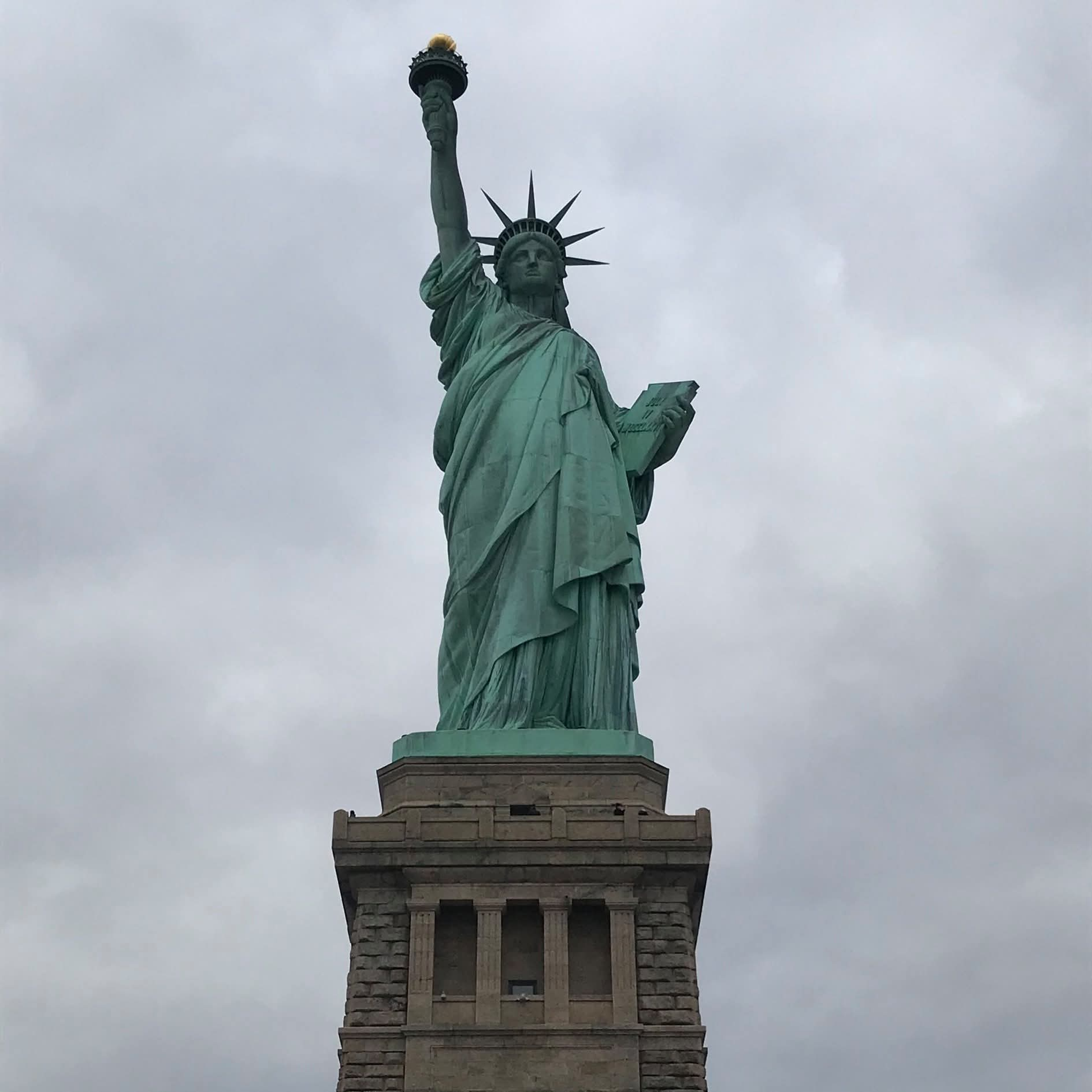 _____________________________________SIGNATURE________________________________________________
Not today Sir, Probably not tomorrow.............................................. bayfront arena st. pete '94
you're finally here and I'm a mess................................................... nationwide arena columbus '10
memories like fingerprints are slowly raising.................................... first niagara center buffalo '13
another man ..... moved by sleight of hand...................................... joe louis arena detroit '140 -
The Ellis Island Museum is amazing. It is so educational and you really get a sense of the history there. I encourage you all to visit when you next are in NYC. You can take a ferry that stops at both Ellis Island and the Statue of Liberty. I have taken people who come to visit me and they have really enjoyed it - that and the Tenement Museum.0
-
January 2, 2026 (Friday)
Just after midnight on January 1, in a private ceremony in the long-closed former City Hall subway station in Manhattan, New York Attorney General Letitia James swore Zohran Mamdani into office as mayor of New York on a historic Quran. Hours later, Senator Bernie Sanders (I-VT) swore Mamdani in publicly in a ceremony on the steps of City Hall.
“My fellow New Yorkers—today begins a new era,” Mamdani said.
The new mayor emphasized that he represents the everyday people of New York City, “construction workers in steel-toed boots and halal cart vendors whose knees ache from working all day” and “neighbors who carry a plate of food to the elderly couple down the hall, those in a rush who still lift strangers' strollers up subway stairs.” “I stand alongside over one million New Yorkers who voted for this day nearly two months ago,” Mamdani said, ”and I stand just as resolutely alongside those who did not…. I promise you this: if you are a New Yorker, I am your Mayor. Regardless of whether we agree, I will protect you, celebrate with you, mourn alongside you, and never, not for a second, hide from you.”
Mamdani identified this era as “an opportunity to transform and reinvent.” “A moment like this comes rarely,” he said, and “[r]arer still is it the people themselves whose hands are the ones upon the levers of change.”
“To those who insist that the era of big government is over,” Mamdani said, “hear me when I say this—no longer will City Hall hesitate to use its power to improve New Yorkers’ lives.
“For too long, we have turned to the private sector for greatness, while accepting mediocrity from those who serve the public. I cannot blame anyone who has come to question the role of government, whose faith in democracy has been eroded by decades of apathy. We will restore that trust by walking a different path—one where government is no longer solely the final recourse for those struggling, one where excellence is no longer the exception.”
Mamdani recalled past city leaders who called for an end to economic and social inequalities and celebrated the “gorgeous mosaic” that is New York City. Men like Bill de Blasio, David Dinkins, and Fiorello La Guardia believed “that New York could belong to more than just a privileged few,” Mamdani said. “It could belong to those who operate our subways and rake our parks, those who feed us biryani and beef patties, picanha and pastrami on rye” if they used the government “to work hardest for those who work hardest.” He promised to “resurrect that legacy.”
He called for everyday Americans to write a new story for New York City, weaving together the many languages, religions, and countries from which they came to become New Yorkers. He promised that city leaders would not try to divide New Yorkers, but rather would work to bring them together. Rather than using “the good grammar of civility…to mask agendas of cruelty,” he said, they would “replace the frigidity of rugged individualism with the warmth of collectivism.”
The policies he promised are not simply about lowering costs, he said, but about “the lives we fill with freedom.” For too long, he said, “freedom has belonged only to those who can afford to buy it.” “Here,” he said, “where the language of the New Deal was born, we will return the vast resources of this city to the workers who call it home.”
Mamdani’s speech was a declaration of a new kind of modern politics that focuses on “freedom to” rather than “freedom from.” For decades, the Republican Party has called for dismantling the government, arguing that regulations and taxes were destroying Americans’ freedom from constraints. But for most Americans, government regulation and investments in social welfare like education and infrastructure guarantee freedom to build a life that is not cramped by preventable obstacles, including those imposed by the wealthy and powerful.
The idea of government regulation and a basic social safety net to permit Americans to live their lives to their fullest potential was a key principle of the New Deal launched by Democratic president Franklin Delano Roosevelt in 1933, and Mamdani was right to note that the New Deal was born in New York City.
It was in New York City that turn-of-the-century reformers like Frances Perkins recognized the desperate need of urban workers for laws that would protect them from workplace injuries, provide a safety net for widows and orphans, and guarantee a living wage. Those reformers worked with the Democratic Tammany Hall machine to push such legislation through the legislature, where it picked up support from Republicans. In the first three years after the 1911 Triangle Shirtwaist Factory fire, New York passed 36 bipartisan laws regulating factories. Other states, especially those with their own history of progressive reform, quickly followed suit.
FDR came from this political ferment, but reform quickly became bipartisan in New York City, where Republicans had their own history of progressivism under Republican president Theodore Roosevelt. In 1933, after a political scandal involving Tammany Hall, New Yorkers elected Republican Fiorello La Guardia to be their mayor after he ran a campaign supporting FDR for president. La Guardia helped to rebuild New York City’s economy during the Great Depression.
By recalling La Guardia and the New Deal, Mamdani was rejecting the modern ideology that demonizes government action rather than celebrating it. He appears to be in good company: an Economist/YouGov poll released on December 30 showed that 80% of Americans believe that “political institutions have been captured by the rich and powerful,” 82% believe that “elites are out of touch with the realities of everyday life,” and 74% believe that “leaders who come from ordinary backgrounds better represent people like me.”
One of Mamdani’s first official acts was designed to restore faith in government by attacking corruption. Mamdami revoked every executive order issued by the previous mayor, Eric Adams, after September 26, 2024. It was on that date that Adams was indicted on five federal charges of public corruption, including bribery, wire fraud, illegal campaign contributions, and conspiracy. After Adams spoke highly of President Donald J. Trump and appeared to agree to cooperate with his immigrant sweeps, the Justice Department in February 2025 moved to drop the charges. The evidence of corruption prompted multiple resignations from the Department of Justice.
In contrast to 34-year-old Mamdani’s inauguration in New York City, the Wall Street Journal on the same day published a story about President Donald Trump’s “signs of aging.” Authors Annie Linskey, Josh Dawsey, and Meridith McGraw note that at 79, Trump is “the oldest man to assume the presidency” and, “according to people close to him,” “is showing signs of aging in public and private.” He gets little sleep and has been recorded falling asleep at public events, appears to be having trouble hearing, doesn’t exercise regularly, and eats “a diet heavy on salty and fatty foods, such as hamburgers and french fries.” Trump told the journalists that he does not always follow the advice of his doctors because “I have very good genetics.”
After learning that the Wall Street Journal was writing about his health, Trump called the authors to “express…irritation about the public debate over his health.” The authors made it clear that Trump and his doctor say he is in excellent health, and his aides say he keeps a busy schedule.
The Wall Street Journal article was significant not because it acknowledges weaknesses many journalists have already recorded, but because a leading right-leaning media outlet is suggesting that Trump is not up to the task of the presidency.
This, in turn, suggests less about the president’s condition than about the danger for the Republican Party of having Trump at its head going into the 2026 midterm elections. On December 31, Republican polling firm Cygnal reported that in generic polling, 49% of Independents favored Democrats and only 29% opted for Republicans. The Independent’s Washington bureau chief, Eric Michael Garcia, called the poll “a flare gun for Republicans.”
Over Tuesday, December 30, and Wednesday, December 31, U.S. Southern Command announced it struck another five small boats that it claims were being operated by “narco-terrorists.” It killed another 13 people and possibly left some survivors. These latest strikes bring the total to at least 35 and the number of people killed to at least 115.
This morning, at 2:58, Trump’s social media account posted about the ongoing Iranian protests that have been sparked by the skyrocketing cost of living, writing: “If Iran shots [sic] and violently kills peaceful protesters, which is their custom, the United States of America will come to their rescue. We are locked and loaded and ready to go. Thank you for your attention to this matter!”
At 6:56 this morning, Trump posted on social media that “The White House Doctors have just reported that I am in ‘PERFECT HEALTH,’ and that I ‘ACED’ (Meaning, was correct on 100% of the questions asked!), for the third straight time, my Cognitive Examination, something which no other President, or previous Vice president, was willing to take. P.S., I strongly believe that anyone running for President, or Vice President, should be mandatorily forced to take a strong, meaningful, and proven Cognitive Examination. Our great country cannot be run by ‘STUPID’ or INCOMPETENT PEOPLE! President DJT.”
Later in the morning, he posted one image of a dead bird near a windmill with the caption “Eagles going down!” and another with birds near windmills saying: “Killing birds by the millions!” MeidasTouch noted that the first image was a 2010 picture of a red kite in Spain and the other was a 2006 image from Taiwan.
Catherine Rampell of The Bulwark asked: “What does it mean when your doctors keep insisting you redo the cognitive exam?”_____________________________________SIGNATURE________________________________________________
Not today Sir, Probably not tomorrow.............................................. bayfront arena st. pete '94
you're finally here and I'm a mess................................................... nationwide arena columbus '10
memories like fingerprints are slowly raising.................................... first niagara center buffalo '13
another man ..... moved by sleight of hand...................................... joe louis arena detroit '140 -
January 3, 2026 (Saturday)
Today was the legal deadline for the Department of Justice to submit to Congress a written justification for any documents from the Epstein files that the department had redacted or withheld. But it seems unlikely the Justice Department met this deadline because it has missed the December 19 deadline for releasing the files themselves. Both of those deadlines were established by the Epstein Files Transparency Act, passed overwhelmingly by Congress on November 19, 2025.
Information from those files continues to trickle out. Those that have been released suggest the Department of Justice considered charging “co-conspirators” and that Trump traveled on Epstein’s private plane with Epstein and his associate Ghislaine Maxwell, along with alleged victims, on several occasions. Mar-a-Lago routinely sent employees to perform massages and other spa services at Epstein’s home, where he exposed himself to those employees. According to Daniel Ruetenik of CBS News, video released on December 23 and 24, 2025, contradicts previous statements about the surveillance system in the prison in which sex offender Jeffrey Epstein was found dead in August 2019.
Trump has taken a hit on his domestic policy lately, as well. After the Supreme Court on December 23, 2025, rejected the administration’s argument that it had the power to deploy federalized National Guard troops in and around Chicago, Trump announced on December 31 that the administration is removing National Guard troops from Chicago, Los Angeles, and Portland. Then he claimed that the troops had “greatly reduced” crime in those cities and vowed to “come back, perhaps in a much different and stronger form, when crime begins to soar again—Only a question of time!”
“Donald Trump’s lying again,” Democratic Illinois governor J.B. Pritzker posted on social media. “He lost in court when Illinois stood up against his attempt to militarize American cities with the National Guard. Now Trump is forced to stand down.” “If President Trump has finally chosen to follow court orders and demobilize our troops,” said Democratic Oregon governor Tina Kotek, “that’s a big win for Oregonians and for the rule of law.”
And then, on New Year’s Eve, Republicans on the House Judiciary Committee released a 255-page transcript of former special counsel Jack Smith’s December 17 closed-door testimony before the committee. The fact they chose to release it at a time when most Americans are not paying attention to the news tells you all you need to know about what Smith said. Republicans have insisted that Smith’s indictments of Trump were a sign that former president Joe Biden’s Justice Department was “weaponized” against Trump and MAGA supporters, but in his testimony—under oath—Smith said Trump was guilty.
As Parker Molloy covered in The Present Age, Smith said that his office had “developed proof beyond a reasonable doubt that President Trump engaged in a criminal scheme to overturn the results of the 2020 election and to prevent the lawful transfer of power. Our investigation also developed powerful evidence that showed that President Trump willfully retained highly classified documents after he left office in January of 2021, storing them at his social club, including in a ballroom and a bathroom. He then repeatedly tried to obstruct justice to conceal his continued retention of those documents.” Smith told the committee that the evidence for the indictment came not from the president’s enemies, but from Republicans who had worked for Trump, campaigned for him, and wanted him to win in 2020.
It is against this backdrop that the Trump administration launched a strike against Venezuela in the early hours of Saturday, January 3. Without consulting Congress, officials ordered the military to seize president Nicolás Maduro and his wife, Cilia Flores, flying them to New York City to face federal charges newly announced by the Southern District of New York.
Trump insists that Maduro is working with the Venezuelan gang Tren de Aragua to attack the U.S. with illegal narcotics. This has been the justification for U.S. strikes on small boats, apparently from Venezuela, that the administration claims have been trafficking drugs to the U.S. The administration has implied the deadly drugs it claims the boats are trafficking are illicit fentanyl, although it has told Congress they were transporting cocaine, which it has now indicted Maduro for trafficking.
But aside from drugs, Trump and his cronies have also increasingly emphasized their conviction that Venezuela “stole” oil from the U.S. and must return it. This appears to be a reference to the loss of U.S. rigs, pipelines, and other facilities when Venezuelan president Carlos Andrés Pérez nationalized the oil companies operating within its borders on January 1, 1976, although Trump might mean the expansion of those seizures under president Hugo Chávez starting in 2007.
This morning, Trump informed the American people of what had happened in Caracas by calling in to Fox & Friends on the Fox News Channel from Mar-a-Lago to describe the strikes and the extraction of Maduro and Flores. He praised the team and boasted that no other country could have done what the U.S. did. "I mean, I watched it literally like I was watching a television show. And, uh… if you would've seen the speed, the violence—you know they say that, ‘the speed, the violence,’ they use that term—it’s uh, just, it was an amazing thing, an amazing job that these people did."
In a midday press conference, members of the administration fleshed out the story of what they are calling “Operation Absolute Resolve.” Although Secretary of State Marco Rubio tried to emphasize that the attack and extraction of Maduro and Flores were a law enforcement mission, Trump made it clear the goal was regime change in order to gain control of Venezuela's oil. The administration acted unilaterally, without consulting Congress, and in apparent violation of international law.
Slurring his words and repeating himself as he read from a script and occasionally wandered off it, Trump called the operation “an assault like people have not seen since World War II” and said it was “one of the most stunning effective and powerful displays of American military might and competence in American history.”
Trump said the U.S. will “run the country until such time as we can do a safe, proper, and judicious transition,” evidently not interested in supporting Edmundo González, the former diplomat who beat Maduro in the 2024 presidential election.
Trump turned immediately to Venezuela’s oil industry, saying that it had been “a total bust…pumping almost nothing by comparison to what they could have been pumping.” He explained that “We're going to have our very large United States oil companies, the biggest anywhere in the world, go in, spend billions of dollars, fix the badly broken infrastructure, the oil infrastructure, and start making money for the country.” “This partnership of Venezuela with the United States of America,” he said, “will make the people of Venezuela rich, independent, and safe.”
If such a mission required U.S. troops on the ground in Venezuela, he said, the administration was not afraid of such deployment.
The president launched into the language of his rally speeches—rote by now—before returning to oil. Although international law is clear that countries own the natural resources within their own territories, he claimed that Venezuela had “unilaterally seized, and sold American oil, American assets and American platforms, costing us billions and billions of dollars…. They took all of our property. It was our property. We built it…and they stole it through force. This constituted one of the largest thefts of American property in the history of our country, considered the largest theft of property in the history of our country.”
And then he hit on the larger foreign policy principle his attack on Venezuela is designed to establish. “America will never allow foreign powers to rob our people and drive us back into and out of our own hemisphere,” he said. He said that the U.S. has now replaced the 1823 Monroe Doctrine—which he called “a big deal” that we “forgot” without explaining that it warned foreign countries from colonizing South America—with the “Donroe Document”: American dominance in the Western Hemisphere.
After World War II, the United States and its allies and partners put in place a rules-based international order to prevent future world conflicts. Under that order, the members of the United Nations agreed they would not threaten or attack another country. Russian president Vladimir Putin has sought to replace that rules-based order with the idea that powerful countries will create spheres of influence in their regions. That new world order would justify Russia’s invasion of Ukraine. Now the U.S. invasion of Venezuela with the promise that the U.S. is going to “run” the country from now on, as part of its quest to dominate the Western Hemisphere, means the U.S. has abandoned the post–World War II international order and is siding with Russia’s vision.
“By proceeding without any semblance of international legitimacy, valid legal authority or domestic endorsement, Mr. Trump risks providing justification for authoritarians in China, Russia and elsewhere who want to dominate their own neighbors,” wrote the New York Times editorial board. That justification seems to be the point.
Trump warned Colombia’s president Gustavo Petro that he has to “watch his ass,” said “Cuba is going to be something we'll end up talking about,” and warned that “something will have to be done about Mexico.” “American dominance in the Western Hemisphere will never be questioned again,” he said. Katie Miller, wife of White House deputy chief of staff Stephen Miller, posted an image of Greenland covered with an American flag and the caption “SOON.”
When Maduro arrived in New York City tonight, official White House social media channels, including that of the president, showed him on his perp walk.
By afternoon, though, the triumphal story seemed to be sagging.
The New York Times reported that at least 40 civilians and military personnel were killed in the attack, which hit a three-story apartment building.
Although Trump told reporters that Venezuelan vice president Delcy Rodríguez had been sworn into the presidency and that she seemed willing to work with the U.S. “to do what we think is necessary to make Venezuela great again,” Rodríguez insisted in a televised address to Venezuelans today that Maduro is the rightful president of Venezuela and must be released, and said the U.S. had “launched an unprecedented military aggression.” “If there is one thing that the Venezuelan people and this country are clear about,” she said, “it is that we will never again be slaves, that we will never again be a colony of any empire, whatever its nature.”
Ben Lefebvre, Zack Colman, and James Bikales of Politico reported that oil companies are leery of Trump’s plan that they will invest billions of dollars in rebuilding Venezuela’s oil industry. Two sources told the journalists that while oil companies would like reimbursement for the equipment and infrastructure they left behind in Venezuela when its government nationalized the oil fields, they are unenthusiastic about Trump’s demand that they invest heavily in rebuilding Venezuela’s destroyed petroleum industry in order to recoup their losses.
They say they have no idea how badly the infrastructure has decayed, and little interest in investing when it is not clear who will be running the country in the future. The administration has failed to reach out to oil executives with a long-term plan, experts told the journalists. One source said “it feels very much a shoot-ready-aim exercise.”
That lack of preparation appears to be in keeping with the overall post-raid planning. Trump told reporters today that administration officials were “designating various people” to “run” Venezuela, “and we're gonna let you know who those people are.” Tonight Robbie Gramer and Juan Forero of the Wall Street Journal said the administration is “racing to assemble an interim governing structure for Venezuela” but noted that “[t]he lack of details about what comes next led some U.S. officials to question why there was no detailed plan in place well before deposing Maduro.”
Gramer and Forero noted that Venezuela is twice the size of California and has 28 million people in it, millions of whom continue to support Maduro, whose government remains largely intact. Those supporters include armed cocaine-trafficking groups, some of whom fought as guerillas in Colombia, and an army of more than 100,000 soldiers.
Current and former U.S. officials told the reporter that the next phase of Trump’s operation in Venezuela is full of risks and the potential for blunders._____________________________________SIGNATURE________________________________________________
Not today Sir, Probably not tomorrow.............................................. bayfront arena st. pete '94
you're finally here and I'm a mess................................................... nationwide arena columbus '10
memories like fingerprints are slowly raising.................................... first niagara center buffalo '13
another man ..... moved by sleight of hand...................................... joe louis arena detroit '140 -
January 4, 2026 (Sunday)
Secretary of State Marco Rubio took the administration’s message about its strikes on Venezuela to the Sunday talk shows this morning. It did not go well.
Asked by George Stephanopoulos of ABC’s This Week under what legal authority the U.S. is going to run Venezuela, as President Donald J. Trump vowed to do, Rubio served up a lot of words but ultimately fell back on the idea that the U.S. has economic leverage over Venezuela because it can seize sanctioned oil tankers. Seizing ships will give the U.S. power to force the Venezuelan government to do as the U.S. wants, Rubio suggested. This is a very different message than Trump delivered yesterday when he claimed that the people standing behind him on the stage—including Rubio—would be running Venezuela.
When Stephanopoulos asked Rubio if he was, indeed, running Venezuela, Rubio again suggested that the U.S. was only pressuring the Venezuelan government by seizing sanctioned oil tankers, and said he was involved in those policies. When Kristen Welker of NBC’s Meet the Press also asked if Rubio was running Venezuela, Rubio seemed frustrated that “People [are] fixating on that. Here's the bottom line on it is we expect to see changes in Venezuela.” Historian Kevin Kruse commented: “Yeah, people are fixating on a Cabinet Secretary being given a sovereign country to run because the president waged war without congressional approval and kidnapped the old leader. Weird that they’d get hung up on that.”
When Stephanopoulos asked why the administration thought it didn’t need congressional authorization for the strikes, Rubio said they didn’t need congressional approval because the U.S. did not invade or occupy another country. The attack, he said, was simply a law enforcement operation to arrest Maduro. Rubio said something similar yesterday, but Trump immediately undercut that argument by saying the U.S. intended to take over Venezuela’s oil fields and run the country.
Indeed, if the strikes were a law enforcement operation, officials will need to explain how officers managed to kill so many civilians, as well as members of security forces. Mariana Martinez of the New York Times reported today that the number of those killed in the operation has risen to 80.
Rubio highlighted again that the Trump administration wants to control the Western Hemisphere, and he went on to threaten Cuba. Simon Rosenberg of The Hopium Chronicles articulated the extraordinary smallness of the Trump administration’s vision when he wrote: “We must also marvel at the titanic idiocy of our new ‘Donroe Doctrine’ for it turns America from a global power into a regional one by choice. I still can't really believe they are going through with this for it is so batsh*t f-ing crazy, and does so much lasting harm to our interests.”
Shortly after Trump told reporters yesterday that Venezuela’s former vice president, now president, Delcy Rodríguez is “essentially willing to do what we think is necessary to make Venezuela great again,” Rodríguez demanded Maduro’s return and said Venezuela would “never again be a colony of any empire, whatever its nature.” Indeed, U.S. extraction of Maduro and threats to “run” Venezuela are more likely to boost the Maduro government than weaken it.
In a phone call today with Michael Scherer of The Atlantic, Trump threatened Rodríguez, saying that “if she doesn’t do what’s right, she is going to pay a very big price, probably bigger than Maduro.” Tonight on Air Force One, Trump told reporters that the U.S., not Rodríguez, is in charge of Venezuela.
Trump also told Scherer that he does indeed intend to continue to assert U.S. control in the Western Hemisphere, telling Scherer that “we do need Greenland, absolutely. We need it for defense.” Greenland is part of the North Atlantic Treaty Organization (NATO), meaning it is already part of U.S. national defense.
Although he ran for office on the idea of getting the U.S. out of the business of foreign intervention, Trump embraced the idea of regime change in Venezuela, telling Scherer: “You know, rebuilding there and regime change, anything you want to call it, is better than what you have right now. Can’t get any worse.” He continued: “Rebuilding is not a bad thing in Venezuela’s case. The country’s gone to hell. It’s a failed country. It’s a totally failed country. It’s a country that’s a disaster in every way.”
At Strength in Numbers, G. Elliott Morris noted that military intervention in Venezuela is even more unpopular with the American people “than Trump’s tariffs and health care cuts.” In September, only 16% of Americans wanted a “U.S. invasion of Venezuela,” with 62% against it. A December poll showed that 60% of likely voters opposed “sending American troops into Venezuela to remove President Maduro from power.” Only 33% approved. Even support for strikes against the small boats in the Caribbean could not get majority support: 53% opposed them while only 42% approved.
“By the time American forces touched Venezuelan soil early Saturday morning,” Morris writes, “Trump had already lost the public.”
But officials in the administration no longer appear to care what the American people want, instead simply gathering power into their own hands for the benefit of themselves and their cronies, trusting that Republican politicians will go along and the American people will not object enough to force the issue. The refusal of the Department of Justice to obey the clear direction of the Epstein Files Transparency Act seems to have been a test of Congress’s resolve, and so far, it is a gamble the administration appears to be winning.
Morris notes that a December CBS poll showed that 75% of Americans, including 58% of Republicans, correctly believed a president must get approval from Congress before taking military action against Venezuela. The president did not get that approval. By law, the president must inform the Gang of Eight before engaging in military strikes, but if an emergency situation prevents that notification, then the president must inform the Gang of Eight within 48 hours. The Gang of Eight is made up of the top leaders of both parties in both chambers of Congress, as well as the top leaders from both parties on the House and Senate Intelligence Committees.
Representative Jim Himes (D-CT) who as ranking member of the House Intelligence Committee is a member of the Gang of Eight, told CBS’s Margaret Brennan this morning that neither he nor House minority leader and fellow Gang of Eight member Hakeem Jeffries (D-NY) had been briefed on the strikes. Himes said: “I was delighted to hear that Tom Cotton, chairman of the Senate Intelligence Committee, has been in regular contact with the administration. I've had zero outreach, and no Democrat that I'm aware of has had any outreach whatsoever. So apparently we're now in a world where the legal obligation to keep the Congress informed only applies to your party, which is really something.”
Senate minority leader Chuck Schumer (D-NY)—also a member of the Gang of Eight—told reporters that he hadn’t been briefed either and that the administration had deliberately misled Congress in three classified briefings before the strikes. In those briefings, officials assured lawmakers that the administration was not planning to take military action in Venezuela and was not pursuing regime change. “They’ve kept everyone in the total dark,” he said.
Nonetheless, Himes told Brennan that he thought Trump’s Venezuelan adventure would not go well: “We're in the euphoria period of…acknowledging across the board that Maduro was a bad guy and that our military is absolutely incredible. This is exactly the euphoria we felt in 2002 when our military took down the Taliban in Afghanistan in 2003, when our military took out Saddam Hussein, and in 2011, when we helped remove Muammar Gaddafi from power in Libya. These were very, very bad people, by the way, much, much worse than Maduro and Venezuela, which was never a significant national security threat to the United States. But we're in that euphoria phase. And what we learned the day after the euphoria phase is that it's an awful lot easier to break a country than it is to actually do what the president promised to do, which is to run it…. [L]et’s let my Republican colleagues enjoy their day of euphoria, but they're going to wake up tomorrow morning knowing what? My God, there is no plan here any more than there was in Afghanistan, Iraq, or in Libya.”
Representative Ted Lieu (D-CA) was more direct: “The U.S. attack on Venezuela is illegal,” he posted. “Congress never authorized this use of military force. I will vote to stop it. This is insane. Health care costs and food prices are surging. Trump’s response is we’re going to run another country. Batsh*t crazy.”_____________________________________SIGNATURE________________________________________________
Not today Sir, Probably not tomorrow.............................................. bayfront arena st. pete '94
you're finally here and I'm a mess................................................... nationwide arena columbus '10
memories like fingerprints are slowly raising.................................... first niagara center buffalo '13
another man ..... moved by sleight of hand...................................... joe louis arena detroit '140 -
January 5, 2026 (Monday)
Five years ago, on January 6, 2021, more than 2,000 rioters stormed the U.S. Capitol to try to stop the process of counting the electoral votes that would make Democrat Joe Biden president of the United States. They tried to hunt down House speaker Nancy Pelosi (D-CA) and chanted their intention to “Hang Mike Pence,” the vice president. They fantasized that they were following in the footsteps of the American Founders, about to start a new nation. Newly elected representative Lauren Boebert (R-CO) wrote on January 5, 2021: “Remember these next 48 hours. These are some of the most important days in American history.” On January 6 she wrote: “Today is 1776.”
In fact, it was not 1776 but 1861, the year insurrectionists who had tried to overthrow the government in order to establish minority rule tried to break the U.S. The rioters wanted to take away the right at the center of American democracy—our right to determine our own destiny—in order to keep Donald J. Trump in the White House, making sure the power of elite white men could not be challenged. It was no accident that the rioters carried a Confederate battle flag.
Since the 1980s, Republicans pushed the idea that a popular government that regulates business, provides a basic social safety net, promotes infrastructure, and protects civil rights crushes the individualism on which America depends. As cuts to regulation, taxation, and the nation’s social safety net began to hollow out the middle class, Republicans pushed the idea that the country’s problems came from greedy minorities and women who wanted to work outside the home. More and more, they insisted that the federal government was stealing tax dollars and destroying society, and they encouraged individual men to take charge of the country.
After the Democrats passed the 1993 National Voter Registration Act, more commonly known as the motor voter law, enabling people to register to vote at motor vehicle departments, Republicans increasingly insisted Democrats were cheating the system by relying on the votes of noncitizens, although there was never any evidence for this charge.
As wealth continued to move upward, the idea that individuals and paramilitary groups must “reclaim” America from undeserving Americans who were taking tax dollars and cheating to win elections became embedded in the Republican Party. By 2014, Senator Dean Heller (R-NV) called Nevada rancher Cliven Bundy and his supporters “patriots” when they showed up armed to meet officials from the Bureau of Land Management who tried to impound Bundy’s cattle because he owed more than $1 million in grazing fees for running cattle on public land.
The idea of reclaiming the country for white men by destroying the federal government grew, along with the idea that Democrats could win elections only by cheating. In 2016, Trump insisted that his female Democratic opponent belonged in jail and that he alone could save the country from the Washington, D.C., “swamp.” Other Republican leaders who had initially shunned him began to support him when it became clear that he could mobilize a new crop of disaffected voters who could put Republicans into office.
And they continued to support him, claiming initially that he could be kept in check by establishment Republicans like his first chief of staff, Reince Priebus, who moved from leading the Republican National Committee to the White House for the first six months of Trump’s first term. In his first months in office, Trump delivered the tax cut Republican leaders wanted, as well as the appointment of one out of every four federal judges, including three Supreme Court justices, who would protect the Republican project in the courts.
But the idea that Trump could be kept in check fell apart in September 2019, when it appeared he was trying to rig the 2020 election. A whistleblower revealed that Trump had called the newly elected president of Ukraine, Volodymyr Zelensky, in July 2019 to demand that Zelensky smear former vice president Joe Biden, who was beating Trump in most polls going into the 2020 election season. Until Zelensky did so, Trump said, the administration would not release the money Congress had appropriated to fund Ukraine’s fight against Russia, which had invaded Ukraine in 2014.
The attempt to withhold congressionally appropriated funds in order to tilt an election was a glaring violation of the 1974 Impoundment Control Act codifying the executive branch’s duty to execute the laws Congress passed. In the congressional investigation that followed, witnesses revealed that Trump’s cronies were running a secret scheme in Ukraine to undermine official U.S. policy and benefit Trump’s allies.
Republicans in 1974 had turned against President Richard Nixon for far less, but although Senator Ted Cruz (R-TX) said not a single Republican senator believed Trump, they stood behind him nonetheless. Senate majority leader Mitch McConnell (R-KY) told his colleagues: “This is not about this president. It’s not about anything he’s been accused of doing…. It’s about flipping the Senate.”
But once acquitted, Trump cut loose from any oversight. He sought revenge and insisted that “[w]hen somebody is President of the United States, the authority is total.” “The federal government has absolute power,” he said, and he had the “absolute right” to use that power if he wanted to.
As early as 2019, Trump had “joked” about staying in power regardless of the 2020 election results, and on October 31, Trump’s ally Steve Bannon told a private audience that Trump was going to declare that he had won the 2020 election no matter what. Trump knew that Democratic mail-in ballots would show up in the vote totals later than Republican votes cast on Election Day, creating a “red mirage” that would be overtaken later by Democratic votes.
“Trump’s going to take advantage of it,” Bannon said, by calling the election early and saying that the later votes were somehow illegitimate. “That’s our strategy. He’s gonna declare himself a winner.” Bannon continued: “Here’s the thing. After then, Trump never has to go to a voter again…. He’s gonna say ‘F*ck you. How about that?’ Because…he’s done his last election.”
Early returns on Election Night 2020, November 3, showed Trump ahead. But, more quickly than anyone expected, Democratic votes turned the key state of Arizona blue, and the Fox News Channel called the race for Biden. Furious, Trump took to the airwaves at about 2:30 the next morning and declared he had won, although ballots were still being counted and several battleground states had no clear winner. “We won’t stand for this,” he told supporters, assuring them he had won. “We’ll be going to the U.S. Supreme Court, we want all voting to stop.”
But it didn’t, and by the time all the ballots were counted, the election was not close: Biden beat Trump by more than 7 million votes and by 306 to 232 in the Electoral College.
Trump insisted a Democrat could not have won honestly. Over the next few months, his campaign demanded recounts, all of which confirmed that Biden won. Trump or his surrogates filed and lost at least 63 lawsuits over the 2020 election, most dismissed for lack of evidence.
As legal challenges failed, Trump pressured Georgia secretary of state Brad Raffensperger to “find 11,780 votes, which is one more than we have” to win the state of Georgia. Trump’s allies plotted for Trump supporters in seven battleground states to meet secretly and submit false slates of electors for Trump. Two slates would enable Vice President Mike Pence to refuse to count the electors from the now-contested states, so that either Trump would be elected outright, or Pence could say there was no clear winner and send the election to the House of Representatives, where each state gets one vote. Since there were more Republican delegations than Democratic ones, Trump would be president.
“This is a fight of good versus evil,” Trump’s evangelical chief of staff Mark Meadows wrote on November 24, 2020, to Supreme Court Justice Clarence Thomas's wife, Ginni.
Determined to retain control of the government, certain congressional Republicans went along with the charade that the election had been stolen. Trump allies in the House began to echo Trump’s accusations and to say they would question the counts from certain states. Such challenges required a paired vote with a senator, and Josh Hawley of Missouri, who saw himself as a top 2024 presidential contender, and Ted Cruz of Texas, who didn’t want to be undercut, led 11 other senators in a revolt to challenge the ballots.
For weeks, Trump had urged his supporters to descend on Washington, D.C., for a “Stop the Steal” rally arranged for January 6, the day Congress would count the certified electoral ballots. Speaking at the Ellipse near the White House that morning, Trump and his surrogates told the crowd that they had won the election, and Trump warned: “We are going to have to fight much harder.”
Trump claimed that Chinese-driven socialists were taking over the country and told the crowd: “We’re gathered together in the heart of our nation's capital for one very, very basic and simple reason: To save our democracy.” “You'll never take back our country with weakness. You have to show strength and you have to be strong. We have come to demand that Congress do the right thing and only count the electors who have been lawfully slated, lawfully slated…. And we fight. We fight like hell. And if you don't fight like hell, you're not going to have a country anymore.
And, knowing they were armed, he told them to march to the Capitol.
As Trump’s supporters attacked, lawmakers from their hiding spots begged the president to call off his supporters, but he did nothing for more than three hours. After 5:40, when the National Guard had been deployed without his orders, thus making it clear the rioters would be overpowered before either taking over the government themselves or giving him an excuse to declare martial law, Trump issued a video statement.
“I know you’re hurt,” he said. “We had an election that was stolen from us. It was a landslide election, and everyone knows it, especially the other side, but you have to go home now…. We love you. You’re very special.” He tweeted: “Remember this day forever!”
When the House of Representatives voted to impeach Trump for a second time on January 13, 2021, for incitement of insurrection, only 10 Republicans voted in favor, while 197 voted no (4 did not vote). In the Senate trial, 7 Republican senators joined the Democrats to convict, while 43 continued to back Trump.
In a speech after his vote to acquit, McConnell said, “There is no question that President Trump is practically and morally responsible for provoking the events of that day,” but said he must answer for his actions in court. “Trump is still liable for everything he did while he was in office,” McConnell said. “We have a criminal justice system in this country. We have civil litigation. And former Presidents are not immune from being held accountable by either one.”
In November 2022, Attorney General Merrick Garland appointed special counsel Jack Smith to investigate Trump’s effort to overturn the 2020 election. On August 1, 2023, a federal grand jury indicted Trump for four felonies associated with his attempt to retain power illegally.
Trump fought back, arguing that he had presidential immunity for his actions. Smith asked the Supreme Court to decide the case immediately, but it waited until the last possible moment, on July 1, 2024, to decide Donald J. Trump v. United States, finding that presidents have “absolute immunity” from criminal prosecution for crimes committed as part of the official acts at the core of presidential powers. Trump himself had appointed three of the justices in the majority.
A second grand jury returned a new indictment stripped of the actions now immune, but by then it was too late: Trump was reelected president, and the Department of Justice has an understanding that it will not indict or prosecute a sitting president. And so, five years after the events of January 6, 2021, we are learning what it means to have a president who has demonstrated his determination to overthrow our democracy and who does not have to answer to the law.
Although he was elected with less than 50% of the votes cast, Trump claimed an “unprecedented and powerful mandate.” As soon as he took office in January 2025, the president and his henchmen flouted the 1974 Impoundment Control Act again, seizing Congress’s right to control the nation’s finances. Trump used emergency powers to ignore the Constitution and deployed troops in Democratic-led cities. When Congress required the Department of Justice to release the Epstein files, the administration largely ignored the law. Today, more than two weeks after the deadline, it had released less than 1% of the files. Ignoring the rights afforded to individuals by the Constitution, Trump is seizing people off the streets and prosecuting his perceived enemies.
Trump has taken on himself the right to go to war with another country in order to take its oil, and is openly working to destroy the rules-based international order that has stabilized the world since the 1940s. Today, White House deputy chief of staff Stephen Miller told CNN’s Jake Tapper: “We live in a world, in the real world, Jake, that is governed by strength, that is governed by force, that is governed by power,” he said. “These are the iron laws of the world since the beginning of time.”
That vision is a profound rejection of the principles of the rules-based international order, which was designed to use power for deterrence rather than domination. It is also a profound rejection of the principles of American democracy, a system of checks and balances to channel power into a government that could deliver stability and prosperity to all the people, not just a select few.
In 1863, when that system was unraveling under pressure from those who wanted to base society on a system of enslavement that enriched an elite, Republican president Abraham Lincoln asked Americans to remember those who had died to protect a nation “conceived in liberty, and dedicated to the proposition that all men are created equal.”
Lincoln asked Americans to “take increased devotion to that cause for which they here, gave the last full measure of devotion,” and to resolve that “these dead shall not have died in vain; that the nation, shall have a new birth of freedom, and that government of the people, by the people, for the people, shall not perish from the earth.”_____________________________________SIGNATURE________________________________________________
Not today Sir, Probably not tomorrow.............................................. bayfront arena st. pete '94
you're finally here and I'm a mess................................................... nationwide arena columbus '10
memories like fingerprints are slowly raising.................................... first niagara center buffalo '13
another man ..... moved by sleight of hand...................................... joe louis arena detroit '140



Categories
- All Categories
- 149.2K Pearl Jam's Music and Activism
- 110.4K The Porch
- 290 Vitalogy
- 35.1K Given To Fly (live)
- 3.5K Words and Music...Communication
- 39.5K Flea Market
- 39.5K Lost Dogs
- 58.7K Not Pearl Jam's Music
- 10.6K Musicians and Gearheads
- 29.1K Other Music
- 17.8K Poetry, Prose, Music & Art
- 1.1K The Art Wall
- 56.8K Non-Pearl Jam Discussion
- 22.2K A Moving Train
- 31.7K All Encompassing Trip
- 2.9K Technical Stuff and Help