Saudi Arms Deal

yosi
NYC Posts: 3,211
Thought this was interesting, and an important read:
Understanding the $60 Billion Saudi Arms Deal: It's About Iran
Last week, the Obama administration unveiled a massive new US-Saudi arms deal. In the days since, the proposed package--which still needs congressional approval--has received relatively little attention from the press and foreign policy pundits (one exception, I should note, is my boss at Eurasia Group, Ian Bremmer). That in itself is surprising, as the deal is striking on at least three counts.
The first is its sheer size. At $60 billion, the sale--which would include 84 F-15 fighter planes, 70 Apache attack helicopters, 72 Blackhawk troop-transport helicopters, and 36 Little Bird surveillance copters--would dwarf any previous US arms deal ever. It's particularly striking in a year when US weapons sales worldwide are down 9 percent.
Second is the fact that, so far at least, the Israeli government--which has often and understandably sought to block arms transactions with Arab states in the past (and just this weekend objected to a new Russian sale of cruise missiles to Syria), has yet to utter a peep of protest. In fact, sources suggest the Israelis have actually blessed the Saudi purchase, in part because the weapons systems are less sophisticated that what Israel gets access to. For example, the Israelis are currently slated to soon buy state-of-the-art F-35s, while the planes the Saudis will be getting are updated versions of a 34-year-old model.
But the real story behind the sale--and it's an element I've yet to see discussed very widely--is the way it may reflect a subtle but significant shift in the US posture toward Iran.
It shouldn't surprise anyone to learn the whole deal is actually about Iran. After all, when the US took out Saddam Hussein, it eliminated the Saudis' only other real enemy except al Qaeda (and you can't use fighter planes against jihadis). The Obama administration admitted as much last week; as a senior administration official told the New York Times on Friday, the deal is meant to show the Iranians "that [their] nuclear program is not getting them leverage over their neighbors, that they are not getting an advantage."
What is surprising, however, is that this deal seems to represent a highly controversial shift in how the administration plans to deal with Iran: from what wonks call (borrowing language from the Cold War) rollback to what's known as containment.
In plain language, the difference is between a policy aimed at stopping Iran from getting nukes (rollback) and one aimed at stopping Iran from using them if, or when, it does (containment). A look at the nature of the weapons Washington is planning to sell Riyadh, which reportedly also include the THAAD anti-ballistic missile defense system and an upgrade to the Saudis' Patriot batteries, makes it clear that the package is meant to help one of Iran's largest neighbors (and a longtime target of Iranian provocation) cope with nuclear-armed and potentially more belligerent Persian state.
Now, this may be highly rational; it certainly seems that way to me. Despite Washington's success this spring passing a new round of sanctions against Iran and gumming up Tehran's illicit weapons program through sabotage and other means, the mullahs continue to make slow progress toward a bomb. Ultimately, nothing short of a military strike is going to keep them from getting one (if that; there's in fact a huge debate over whether even a US or Israeli strike could set back Iran's march to nuclear precipice by more than a year or so).
But shifting from rollback to containment, even if it's the more realistic policy and done quietly, is still a dangerous move for the Obama administration, for several reasons. First, making the switch by funneling unprecedented quantities of firepower to the Saudis could fall flat, or even backfire. The kingdom has already been the largest purchaser of US arms for some time now, and despite that fact, has proved utterly incapable of defending itself and its massive oil fields. Second, by upping the quantity of weapons dramatically, the administration risks igniting a regional arms race. (It's worth noting that in 2008, the tiny United Arab Emirates actually spent even more on armaments than the Saudis did.). Apart from its inherent dangers, such a escalatory cycle would pose a major PR problem for a White House that has made global arms reduction a major part of its policy agenda.
The third issue is by far the most delicate. Since taking office, skeptical hawks in both Washington and Jerusalem have watched the Obama administration like... well, hawks for signs that it may not be prepared to stand behind its avowed commitment to keep all "options on the table" when it comes to Iran--code words for preserving the option to use a military strike if all other means of halting Iran's nuclear program fail. Maintaining the credibility of that threat is critical to the administration at the moment, both because it keeps the Israelis from taking matters into their own hands and because it gives Iran extra motivation to consider negotiations.
To persuade the doubters of its mettle, the administration has resorted to a variety of measures in recent years, including engaging in contingency planning, holding frequent briefings with the Israelis, and trotting out Rahm Emmanuel to insist to Jeffrey Goldberg that it had not ruled out "counterproliferation by force." In recent months, these gestures seemed to be succeeding. But if failsafe moves like this Saudi sale start persuading the skeptics that Obama has lost his nerve, it could unleash a whole set of nasty consequences for the administration. These include strident attacks from Republicans going into the midterm elections and the presidential campaigning that will start soon after. They could also include a range of destabilizing Israeli moves, from withdrawing from the peace process--which Prime Minister Benjamin Netanyahu probably only engaged in to secure US cooperation on Iran--to reconsidering a military strike of its own.
None of this means the Saudi deal is a mistake. But it does mean the stakes are a lot higher than most people seems to recognize.
UPDATE: This morning, the FT reported that the UAE has just signed military supply contracts for $35-40 billion and that by 2014, Oman is expected to shell out $12 billion and Kuwait some $7 billion for arms, in what the FT calls "one of the largest re-armament exercises in peacetime history." Seems the regional buying bonanza has already begun.
Understanding the $60 Billion Saudi Arms Deal: It's About Iran
Last week, the Obama administration unveiled a massive new US-Saudi arms deal. In the days since, the proposed package--which still needs congressional approval--has received relatively little attention from the press and foreign policy pundits (one exception, I should note, is my boss at Eurasia Group, Ian Bremmer). That in itself is surprising, as the deal is striking on at least three counts.
The first is its sheer size. At $60 billion, the sale--which would include 84 F-15 fighter planes, 70 Apache attack helicopters, 72 Blackhawk troop-transport helicopters, and 36 Little Bird surveillance copters--would dwarf any previous US arms deal ever. It's particularly striking in a year when US weapons sales worldwide are down 9 percent.
Second is the fact that, so far at least, the Israeli government--which has often and understandably sought to block arms transactions with Arab states in the past (and just this weekend objected to a new Russian sale of cruise missiles to Syria), has yet to utter a peep of protest. In fact, sources suggest the Israelis have actually blessed the Saudi purchase, in part because the weapons systems are less sophisticated that what Israel gets access to. For example, the Israelis are currently slated to soon buy state-of-the-art F-35s, while the planes the Saudis will be getting are updated versions of a 34-year-old model.
But the real story behind the sale--and it's an element I've yet to see discussed very widely--is the way it may reflect a subtle but significant shift in the US posture toward Iran.
It shouldn't surprise anyone to learn the whole deal is actually about Iran. After all, when the US took out Saddam Hussein, it eliminated the Saudis' only other real enemy except al Qaeda (and you can't use fighter planes against jihadis). The Obama administration admitted as much last week; as a senior administration official told the New York Times on Friday, the deal is meant to show the Iranians "that [their] nuclear program is not getting them leverage over their neighbors, that they are not getting an advantage."
What is surprising, however, is that this deal seems to represent a highly controversial shift in how the administration plans to deal with Iran: from what wonks call (borrowing language from the Cold War) rollback to what's known as containment.
In plain language, the difference is between a policy aimed at stopping Iran from getting nukes (rollback) and one aimed at stopping Iran from using them if, or when, it does (containment). A look at the nature of the weapons Washington is planning to sell Riyadh, which reportedly also include the THAAD anti-ballistic missile defense system and an upgrade to the Saudis' Patriot batteries, makes it clear that the package is meant to help one of Iran's largest neighbors (and a longtime target of Iranian provocation) cope with nuclear-armed and potentially more belligerent Persian state.
Now, this may be highly rational; it certainly seems that way to me. Despite Washington's success this spring passing a new round of sanctions against Iran and gumming up Tehran's illicit weapons program through sabotage and other means, the mullahs continue to make slow progress toward a bomb. Ultimately, nothing short of a military strike is going to keep them from getting one (if that; there's in fact a huge debate over whether even a US or Israeli strike could set back Iran's march to nuclear precipice by more than a year or so).
But shifting from rollback to containment, even if it's the more realistic policy and done quietly, is still a dangerous move for the Obama administration, for several reasons. First, making the switch by funneling unprecedented quantities of firepower to the Saudis could fall flat, or even backfire. The kingdom has already been the largest purchaser of US arms for some time now, and despite that fact, has proved utterly incapable of defending itself and its massive oil fields. Second, by upping the quantity of weapons dramatically, the administration risks igniting a regional arms race. (It's worth noting that in 2008, the tiny United Arab Emirates actually spent even more on armaments than the Saudis did.). Apart from its inherent dangers, such a escalatory cycle would pose a major PR problem for a White House that has made global arms reduction a major part of its policy agenda.
The third issue is by far the most delicate. Since taking office, skeptical hawks in both Washington and Jerusalem have watched the Obama administration like... well, hawks for signs that it may not be prepared to stand behind its avowed commitment to keep all "options on the table" when it comes to Iran--code words for preserving the option to use a military strike if all other means of halting Iran's nuclear program fail. Maintaining the credibility of that threat is critical to the administration at the moment, both because it keeps the Israelis from taking matters into their own hands and because it gives Iran extra motivation to consider negotiations.
To persuade the doubters of its mettle, the administration has resorted to a variety of measures in recent years, including engaging in contingency planning, holding frequent briefings with the Israelis, and trotting out Rahm Emmanuel to insist to Jeffrey Goldberg that it had not ruled out "counterproliferation by force." In recent months, these gestures seemed to be succeeding. But if failsafe moves like this Saudi sale start persuading the skeptics that Obama has lost his nerve, it could unleash a whole set of nasty consequences for the administration. These include strident attacks from Republicans going into the midterm elections and the presidential campaigning that will start soon after. They could also include a range of destabilizing Israeli moves, from withdrawing from the peace process--which Prime Minister Benjamin Netanyahu probably only engaged in to secure US cooperation on Iran--to reconsidering a military strike of its own.
None of this means the Saudi deal is a mistake. But it does mean the stakes are a lot higher than most people seems to recognize.
UPDATE: This morning, the FT reported that the UAE has just signed military supply contracts for $35-40 billion and that by 2014, Oman is expected to shell out $12 billion and Kuwait some $7 billion for arms, in what the FT calls "one of the largest re-armament exercises in peacetime history." Seems the regional buying bonanza has already begun.
you couldn't swing if you were hangin' from a palm tree in a hurricane
Post edited by Unknown User on
0
Comments
-
I don't really like the Saudi culture and if they didn't have oil, the U.S. wouldn't give them the time of day.
That said, this looks like a cold war weapons build up.Be Excellent To Each OtherParty On, Dudes!0 -
maybe we feel like we owe them something since we have bases on their land and have been launching attacks from saudi land for ages."You can tell the greatness of a man by what makes him angry." - Lincoln
"Well, you tell him that I don't talk to suckas."0 -
containment?
how dumb do they think Iran is?
the US is itching for an excuse to invade Iran, if they made 1 move towards expansion they would reduced to third world status in a matter of days. there is no need to be handing out high tech weaponry undemocratic saudi arabia.0 -
just a terrible idea, although considering the history between the U.S. and Saudi, it's really not that surprising.
dear old dubya and his pal Bandar. aren't they just adorable.
i wonder if they are discussing how the U.S. is the super duper uber awesome liberator of the worlds freedoms, and even though Bush has known since a month after 9/11 that 15 of the WTC terrorists were Saudi, he is going to bomb the living shit out of Iraq and call it war.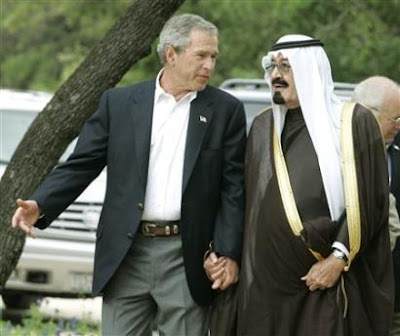
fool me once, shame on you. fool me twice, shame on me.0 -
TriumphantAngel wrote:just a terrible idea, although considering the history between the U.S. and Saudi, it's really not that surprising.
dear old dubya and his pal Bandar. aren't they just adorable.
i wonder if they are discussing how the U.S. is the super duper uber awesome liberator of the worlds freedoms, and even though Bush has known since a month after 9/11 that 15 of the WTC terrorists were Saudi, he is going to bomb the living shit out of Iraq and call it war.
fool me once, shame on you. fool me twice, shame on me.
great point.
the US is the one to fear in the region, not Iran.0 -
Well, the people who are actually in the region apparently don't think so.you couldn't swing if you were hangin' from a palm tree in a hurricane0
-
i get your point about other countries in the region fearing iran, but if those countries were friendly with the US like saudi arabia and israel and others, then they would have nothing to fear, because america would assist or maybe even fight their battles for their, as w called them, "friends". that is why the us should be the feared entity in that region.yosi wrote:Well, the people who are actually in the region apparently don't think so."You can tell the greatness of a man by what makes him angry." - Lincoln
"Well, you tell him that I don't talk to suckas."0 -
TriumphantAngel wrote:just a terrible idea, although considering the history between the U.S. and Saudi, it's really not that surprising.
dear old dubya and his pal Bandar. aren't they just adorable.
i wonder if they are discussing how the U.S. is the super duper uber awesome liberator of the worlds freedoms, and even though Bush has known since a month after 9/11 that 15 of the WTC terrorists were Saudi, he is going to bomb the living shit out of Iraq and call it war.
fool me once, shame on you. fool me twice, shame on me.
actually bush completely screwed up that quote...

http://www.youtube.com/watch?v=eKgPY1adc0A"You can tell the greatness of a man by what makes him angry." - Lincoln
"Well, you tell him that I don't talk to suckas."0 -
Gimme, I'm sorry, but I don't follow the argument you're making?
Commy, Iraq was a disaster. Still, I think it would depend on who you asked. The Kurds, for example, are probably not disposed to thinking of the U.S. as the greatest danger to them.you couldn't swing if you were hangin' from a palm tree in a hurricane0 -
considering US support for Turkey in the 80's and 90's and even today has been responsible for tens of thousands of Kurds being murdered, you would be wrong.yosi wrote:Gimme, I'm sorry, but I don't follow the argument you're making?
Commy, Iraq was a disaster. Still, I think it would depend on who you asked. The Kurds, for example, are probably not disposed to thinking of the U.S. as the greatest danger to them.0 -
you understand what i am saying. if your middle eastern country is allied with the US then you have nothing to fear from iran or any other country that has a contentious relationship with the US because the US will either:yosi wrote:Gimme, I'm sorry, but I don't follow the argument you're making?
Commy, Iraq was a disaster. Still, I think it would depend on who you asked. The Kurds, for example, are probably not disposed to thinking of the U.S. as the greatest danger to them.
a. help arm your country
b. put troops there and establish bases to protect your country
c. fight alongside your military
d. fight the battle for you
e. sanction the hell out of iran or whatever enemy you have
all of these are terrible things and if iran were to attack any of its neighbors that are on friendly terms with the US, it will be a matter of days before the US joins the battle. and for that reason, the US should be more feared than iran. not to mention all of the business interests and energy interests that the US has to "protect" for ourselves in that region, which makes us EXTREMELY dangerous..."You can tell the greatness of a man by what makes him angry." - Lincoln
"Well, you tell him that I don't talk to suckas."0 -
Ok, now I understand. But in that scenario isn't it still Iran who is doing the initial attacking?you couldn't swing if you were hangin' from a palm tree in a hurricane0
-
IF iran attacks those things will most likely happen. but we have resources and business interests there, and we have pre-emptively attacked iraq already, what is to keep us, or israel, or some other country from doing the same thing to iran as iraq? iran is scared of that happening, so why would they carry out an attack if they know that they will be dealt with harshly possibly from many countries??yosi wrote:Ok, now I understand. But in that scenario isn't it still Iran who is doing the initial attacking?"You can tell the greatness of a man by what makes him angry." - Lincoln
"Well, you tell him that I don't talk to suckas."0 -
Doesn't that same logic dictate that Iran would stop fucking around and stone walling on its nuclear program?you couldn't swing if you were hangin' from a palm tree in a hurricane0
-
how is it stonewalling? it started usning the technology for power plants. besides, if israel and pakistan have nukes, isn't it only natural for iran to want them for their own protection?yosi wrote:Doesn't that same logic dictate that Iran would stop fucking around and stone walling on its nuclear program?"You can tell the greatness of a man by what makes him angry." - Lincoln
"Well, you tell him that I don't talk to suckas."0 -
Just about every intelligence agency in the world has come out and said that they are running a secret arms program. I really don't think there is any debate about that. As for wanting it for defense from Israel and Pakistan, neither of those countries border Iran (so it's not like there's any impending invasion), I'm not aware of a history of conflict between Iran and Pakistan, and until Iran started arming/funding/training terrorists killing Israelis, talking about destroying Israel, and building nukes, Israel, to my knowledge, never gave any indication whatsoever, of seeking hostilities with Iran. If anything, the nuclear program has increased the likelihood that someone will attack Iran preemptively.you couldn't swing if you were hangin' from a palm tree in a hurricane0
-
yosi wrote:Just about every intelligence agency in the world has come out and said that they are running a secret arms program. I really don't think there is any debate about that. As for wanting it for defense from Israel and Pakistan, neither of those countries border Iran (so it's not like there's any impending invasion), I'm not aware of a history of conflict between Iran and Pakistan, and until Iran started arming/funding/training terrorists killing Israelis, talking about destroying Israel, and building nukes, Israel, to my knowledge, never gave any indication whatsoever, of seeking hostilities with Iran. If anything, the nuclear program has increased the likelihood that someone will attack Iran preemptively.
does this include the same intelligence agency who determined there were WMD in iraq?? :think:hear my name
take a good look
this could be the day
hold my hand
lie beside me
i just need to say0 -
That's really not such a good argument. If anything, the fact that they were so spectacularly wrong with Iraq would make them more reticent to go out on a limb this time around.you couldn't swing if you were hangin' from a palm tree in a hurricane0
-
it seems there were plenty of tensions between israel and iran before this, remember when they were called "the little satan" by Khomeini?yosi wrote:Just about every intelligence agency in the world has come out and said that they are running a secret arms program. I really don't think there is any debate about that. As for wanting it for defense from Israel and Pakistan, neither of those countries border Iran (so it's not like there's any impending invasion), I'm not aware of a history of conflict between Iran and Pakistan, and until Iran started arming/funding/training terrorists killing Israelis, talking about destroying Israel, and building nukes, Israel, to my knowledge, never gave any indication whatsoever, of seeking hostilities with Iran. If anything, the nuclear program has increased the likelihood that someone will attack Iran preemptively.
i am not sure how accurate this link is since it can be edited by anyone, and some countries have been known to pay people to edit out unsavory deatils, but that is from a thread a few weeks ago... but there are instances of tensions between israel and iran there.
http://en.wikipedia.org/wiki/Iran%E2%80 ... _relations
and what does any of this have to do with the arms deal between the us and the saudis?"You can tell the greatness of a man by what makes him angry." - Lincoln
"Well, you tell him that I don't talk to suckas."0



Categories
- All Categories
- 149.1K Pearl Jam's Music and Activism
- 110.2K The Porch
- 282 Vitalogy
- 35.1K Given To Fly (live)
- 3.5K Words and Music...Communication
- 39.3K Flea Market
- 39.3K Lost Dogs
- 58.7K Not Pearl Jam's Music
- 10.6K Musicians and Gearheads
- 29.1K Other Music
- 17.8K Poetry, Prose, Music & Art
- 1.1K The Art Wall
- 56.8K Non-Pearl Jam Discussion
- 22.2K A Moving Train
- 31.7K All Encompassing Trip
- 2.9K Technical Stuff and Help